

If you’ve ever searched for trampoline replacement parts or even just stood next to your own backyard trampoline wondering how it all works, chances are you’ve asked the same thing:
What’s the part you actually jump on called?
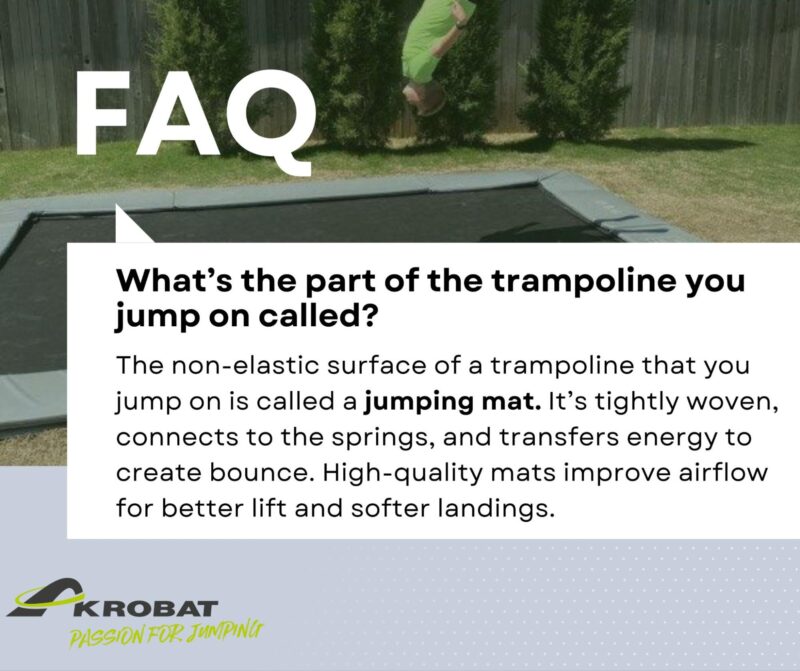
In this guide, we’re going to walk you through everything you need to know about it:
✅ What it is,
✅ How it works,
✅ When to replace it,
✅ And why quality matters more than you think.
What the Jumping Mat Actually Does (It’s Not Just Fabric)
To the untrained eye, the jump mat might look like a big sheet of woven fabric. The jumping mat is not elastic. That surprises most people. The real bounce (the energy return, the height, the lift) comes from the springs, not the mat itself.
Let us explain how it really works.
Built for Bounce, Not Elasticity

When you jump on a trampoline, your weight drives down into the non-stretchable jump mat. The mat’s job is to immediately transfer that energy to the coiled steel springs connecting it to the frame. The mat stays taut and acts like a suspension bridge; it doesn’t stretch itself, but it moves just enough to redirect your energy into the springs, which compress and then release it back up into your body. That’s what creates the bounce.
Core Role in Trampoline Performance

Your bounce quality; how high, how soft, how consistent, is directly tied to the mat’s material, stitching integrity, and air permeability. It’s not just a surface you land on; it’s the performance engine of the trampoline.
This is why our AkroVENT® jump mats stand out. We designed them with strategically woven airflow zones that allow air to pass through the mat as you jump, rather than trapping it underneath. That one small shift changes everything:
- Better airflow = smoother rebound
- Less resistance = higher jumps
- Reduced pressure on your joints
The AkroVENT® design also eliminates the loud slap you get from budget mats, where trapped air gets compressed and released with each bounce. What you get instead is a quiet, powerful, clean jump, like a professional-grade system without the harsh string beds you’ll find in trampoline parks.
And that’s the difference between a toy and a tool.
Jump Mat Materials Explained: What’s It Made From?
The jump mat has to do a deceptively complex job: remain rigid under force, survive years of weather exposure and deliver consistent bounce performance. That takes more than just strong fabric, it takes the right kind of engineering.
Woven Polypropylene or Permatron®
Most high-quality jump mats today are made from woven polypropylene; a high-tensile, weather-resistant thermoplastic polymer. In the premium space, you’ll often see Permatron®, a branded type of polypropylene designed specifically for high-flex applications like trampolines. Both are UV-resistant, tear-resistant, and formulated to take repeated impact without degrading.
This is miles ahead of the older canvas-style mats, which were popular decades ago and tend to stretch, fade, and trap water. Today’s woven mats maintain their shape far longer, are easier to clean, and offer a more consistent bounce every time.
The Case for Airflow
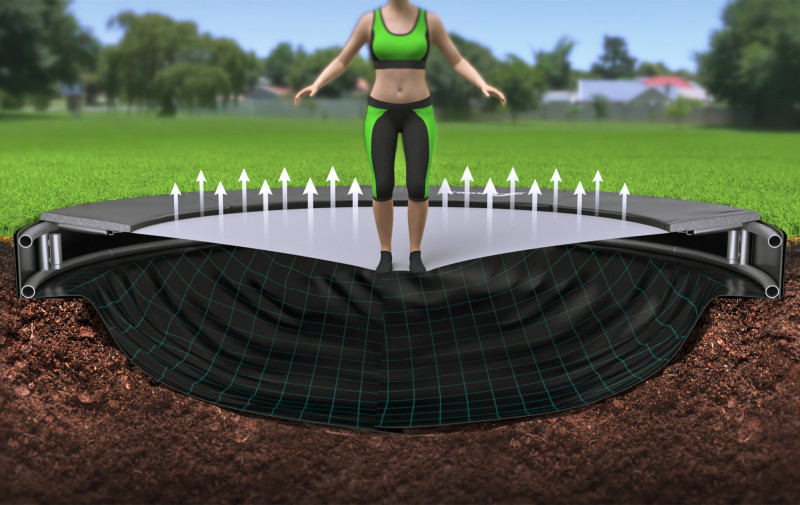
Now, here’s where we’ve taken things a step further. Our proprietary AkroVENT® mat is designed with a strategically engineered airflow pattern, a breathable weave that allows air to move through the mat instead of fighting against it.
Why does that matter?
Because when you jump on a solid mat, you’re compressing a pocket of air beneath your body. That air creates drag, it fights your rebound and slows you down. With AkroVENT®, you eliminate that resistance. Air escapes naturally, which means your jumps are higher, smoother, and softer on your joints.
And there’s a second, underrated benefit: quick-dry performance.
If you’re training in humid environments, have kids using the trampoline barefoot, or simply want a safer bounce experience, airflow matters more than you think. And with Akrobat, airflow is built right into the mat, not added as an afterthought.
This is the kind of attention to detail that separates serious engineering from backyard gimmicks. Because when your mat performs better, everything else does too.
How to Know If You Need a New Jumping Mat
Trampolines are built for repeated impact but nothing lasts forever, especially when exposed to the elements, intense usage, or subpar installation. Let’s walk through the signs that tell you it’s time to stop bouncing and start inspecting.
Signs Your Mat Needs Replacement
The most obvious sign? Visible wear and tear. If your mat shows sagging, fraying, fading, or tearing, you’re overdue for a replacement. A mat in that condition compromises both safety and bounce control.
But even before visible damage appears, there are subtler signs worth catching early:
- Loose stitching around the perimeter or attachment rings.
- Surface warping, where the center sits lower than the edges.
- Unstable bounce one side feels “dead” or less responsive.
- Creaking or shifting sounds often mistaken for frame issues, but can be the mat straining against uneven spring tension.
**note: not all bounce issues are caused by the mat itself. Sometimes, the real problem is weakened springs or a misaligned frame but the mat is where you’ll feel it first.
🔗Looking For a Mat Replacement? We Got You Here
What If My Mat Is Sagging But Not Ripped?
Mat sag without tears is usually a symptom, not a cause. It’s often the first sign that your springs are stretched out or your frame has shifted out of alignment. When the springs lose tension, the mat can no longer maintain its taut surface and the bounce becomes unpredictable, sluggish, and potentially dangerous.
Jumping on a sagging mat introduces:
- Uneven loading across the frame.
- Increased risk of bottoming out on the ground.
- Inconsistent bounce trajectories, especially risky for kids and athletes doing flips or tricks.
If your mat is sagging but still intact, inspect your spring integrity before blaming the fabric. If everything else checks out, it might just be time for a new mat.
The Jumping Mat vs. Other Trampoline Parts
Let’s clear up the confusion once and for all.
Not to Be Confused With…
➤ Spring Pad (Also Called Safety Pad)
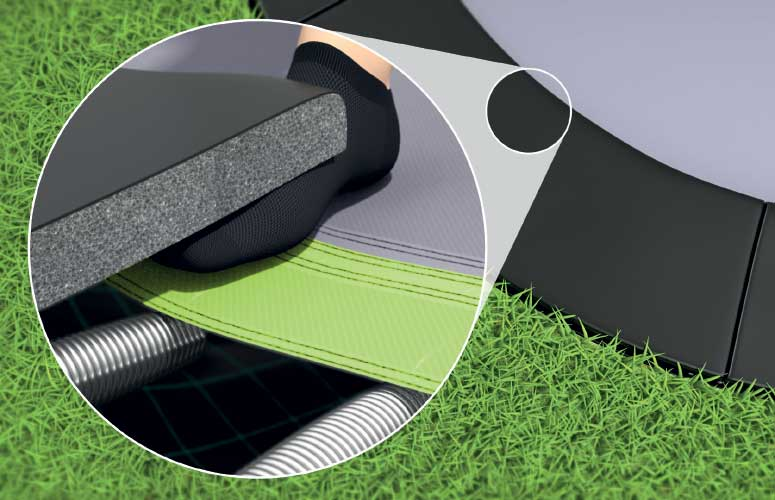
This is the padded ring that covers the springs and frame perimeter. Its job is to protect jumpers from falling through the spring gaps or landing on exposed metal, not to bounce on.
🛒Check Out Akrobat’s Trampoline Replacement Pads Here
➤ Enclosure Net
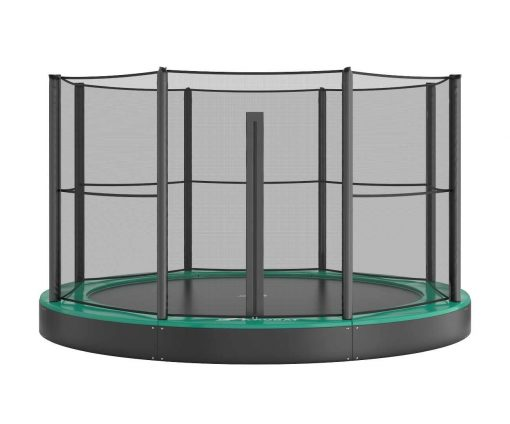
This surrounds the trampoline vertically, usually attached to poles rising above the frame. Its sole purpose is to prevent jumpers from falling off the trampoline. It’s made of mesh or polyethylene, not bounceable in any way. Yet, I’ve seen plenty of people refer to this as “the net you jump on” which leads to incorrect orders and wasted money.
🔗Find Akrobat’s Trampoline Enclosures Here
So here’s the rule: if it’s not stretched taut and directly connected to the springs, it’s not the jump mat.
Know What You’re Jumping On
Whether you’re coaching a young athlete, jumping with your kids after work, or just trying to keep your equipment in top shape, knowing what the jump mat is, how it works, and when it needs replacing can make all the difference. It means better bounce quality, fewer injuries, longer equipment life.
And if you’re not sure where to start? That’s what we’re here for.
We’ve built our reputation on top-tier materials, unmatched durability, and a team that genuinely cares about your trampoline experience. So whether you’re shopping for a replacement mat or building your dream backyard setup from scratch, we’ll help you find the best fit.
