
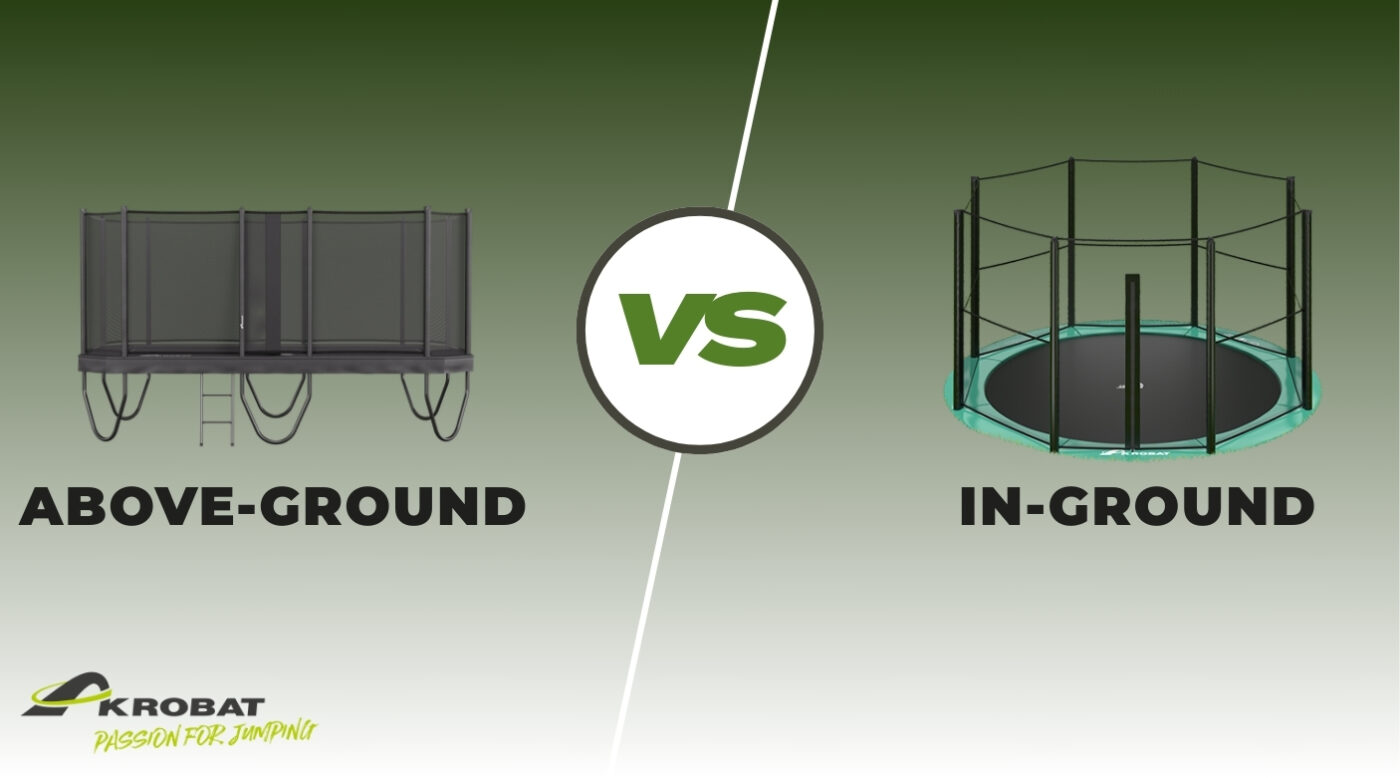
Choosing a trampoline is a decision that affects your yard, your family’s safety, your wallet, and how much joy you actually get out of the product over time.
Whether you’re a parent weighing aesthetics against performance, or an athlete looking for the best bounce, you’re likely here for one reason: to understand the real-world difference between in-ground vs. above-ground trampolines.
We’ll break down everything you need to know: from how each type affects bounce height, installation, and safety, to lesser-known factors like drainage problems, resale issues, and how spring configuration can make or break your jump.
We’ll also share tips that help you avoid costly mistakes.By the end, you’ll not only know which trampoline is right for your situation: you’ll be equipped to make the right choice for your yard, your lifestyle, and your peace of mind.
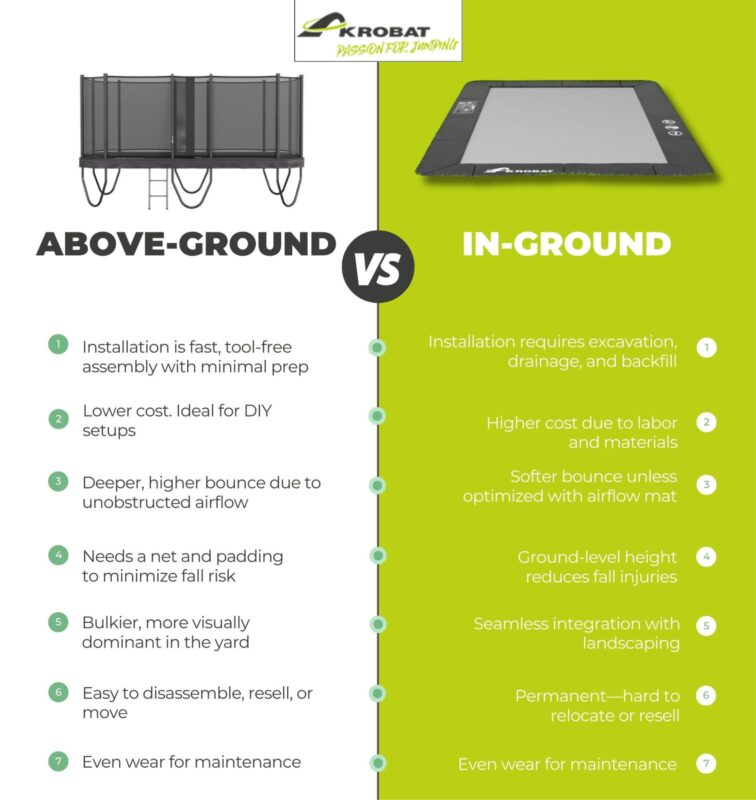
Quick Comparison Table: In-Ground vs. Above-Ground Trampolines
What Is an In-Ground Trampoline?
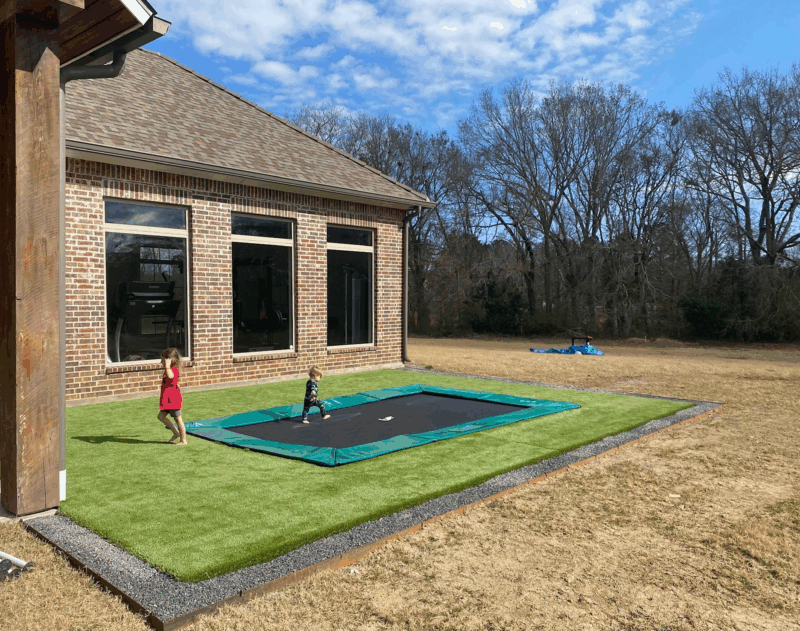
Product Featured -> 17ft x 10ft Akrobat Primus In-Ground Trampoline – Green (Green Pad with Black Jump Mat)
An in-ground trampoline is installed flush with your lawn. The galvanized steel frame sits below ground level, resting inside a carefully dug pit reinforced with backfill and a weed barrier.
The jumping surface remains level with the grass, making it an unobtrusive addition to any backyard.
Why Choose It?
- In-ground trampolines offer a visually clean look
- Many families prefer them for the safety advantage, kids don’t have to climb up, and there’s less risk of high falls.
- They’re also favored in neighborhoods with HOA restrictions, where preserving curb appeal matters just as much as fun.
This setup is especially helpful for toddlers and children with limited mobility, who benefit from walk-on access without ladders or steps. And if you’re working with a designed outdoor space, it can blend into gardens or patio areas far better than a structure sitting several feet in the air.
What to Consider
What you gain in design and ease-of-use, you trade for complexity and commitment.
Drainage must be accounted for, flooded pits aren’t just inconvenient; they can ruin frames, cause mold, and attract pests. The excavation process may not be inexpensive or easy, especially in rocky or clay-heavy soil.
Once it’s installed, it’s installed. You’re not moving it, or selling it, without major work.
What Is an Above-Ground Trampoline?
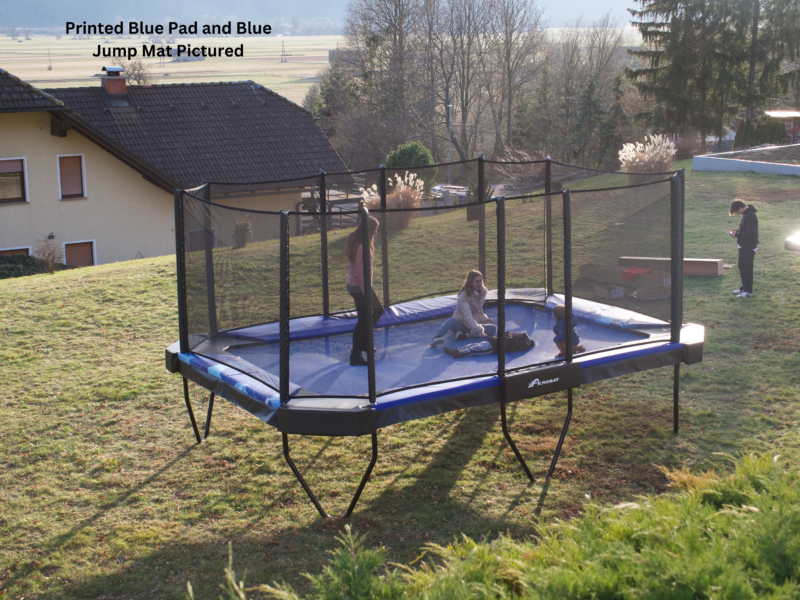
Product Featured -> XCITYX 17ft x 12ft Akrobat Above Ground Trampoline – Printed Blue Pad and Blue Jump Mat
Above-ground trampolines are what most families picture when they think of a backyard bounce. These units are elevated on galvanized steel legs, with the frame and springs fully visible above the lawn.
They’re fast to set up, and come in many sizes, shapes, and configurations, especially in the popular rectangular trampoline format for performance use.
Why Choose It?
Above-ground trampolines offer unmatched convenience. You don’t need a contractor or heavy equipment. With our AkroCLICK® system, most setups require no tools at all, click the frame together, and you’re bouncing within hours.
Airflow is also slightly more efficient, giving you a livelier, more athletic bounce straight out of the box. That’s one reason above-ground units are often preferred by gymnasts, trickers, and teens working on flips or jumps.
They’re also easier to replace, resell, or store for the winter, something that’s not feasible with an in-ground model.
What to Consider
These trampolines are more exposed. The frame, mat, and springs are visible, which can clash with landscaping. The elevated frame requires a step-up, making it harder for small children to access. It can also raise fall risk if not paired with a quality enclosure net. Wind may also be an issue with above ground trampolines that is not associated with in-ground trampolines.
Additionally, without regular repositioning or mats underneath, you may see grass damage due to sun blockage or trapped moisture.
Bounce Quality – Is One Really Bouncier Than the Other?
The Science of Bounce: Why Airflow Matters
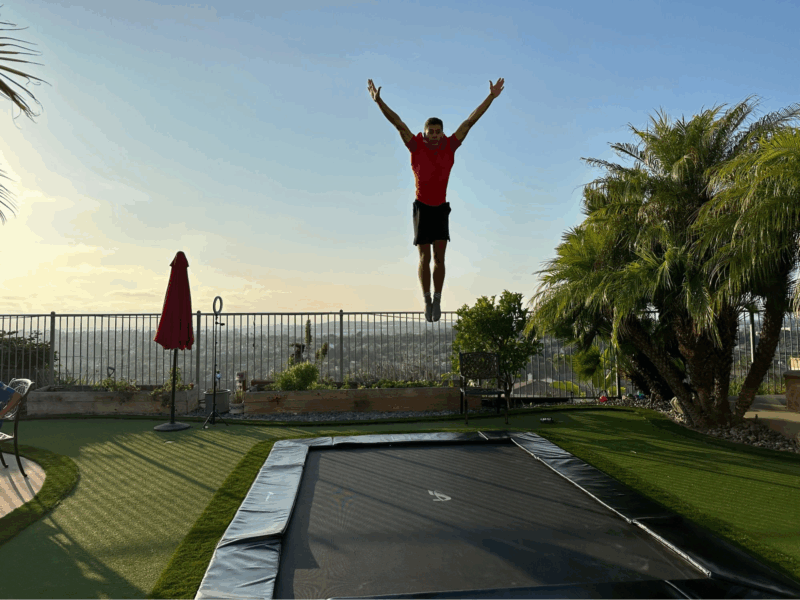
The secret to trampoline performance often lies below the surface, literally.
Above-ground trampolines allow unrestricted airflow beneath the jump mat. That air escapes easily with each jump, allowing the springs to fully engage and creating a crisp, powerful rebound. This airflow dynamic is one of the reasons athletes often gravitate toward above-ground designs for competitive bounce and trick performance.
In contrast, other brands of in-ground trampolines can suffer from what many refer to as a “dead bounce” if the air doesn’t flow properly. When trapped air has nowhere to go, the mat resists compression. With Akrobat’s AkroVENT sport jump mat this is not an issue. Without a vented jumping surface or side ducts, this can significantly reduce lift, leaving jumpers frustrated with a flat, muted response. Our developing team took the Akrobat trampoline design to a completely different level with its top feature – a ventilating jumping mat that leaves the frame pads securely attached, preventing annoying pad lifting and slapping noise. Ventilating air through the jumping mat instead of on the sides makes Akrobat trampolines not just quieter but also safer to use. The extra protective edge covers the springs, so the jumpers will not accidentally injure their foot between a spring while jumping. The effective system with 70% air permeability provides the experience of virtually no air resistance when jumping, which allows for an unforgettable jump experience.
We’ve seen this firsthand in testing. In-ground trampolines without proper ventilation often disappoint families who expected the same bounce as an above-ground model, and didn’t know airflow was the culprit.
Fixing the Bounce Problem for In-Ground Trampolines
The bounce issue isn’t inevitable, it’s fixable. We’ve engineered solutions that make our in-ground trampolines perform at their full potential:
- Use high-permeability mats like AkroVENT®: Akrobat’s AkroVENT® mat dramatically improves airflow by allowing air to pass through the surface instead of trapping it beneath. This creates a smoother, higher jump without compromising safety or control.
- Never bury an above-ground model: It might seem like a shortcut, but burying a non-vented, above-ground trampoline almost always leads to performance failure. These frames aren’t built for underground conditions, and their mat and spring systems aren’t designed for the airflow restrictions of a pit. The result? Weak bounce, faster wear, and a much bigger safety risk.
Is More Bounce Always Better?
Not necessarily. Higher bounce is great for flips, tricks, and athletic use, but it comes with trade-offs. The more bounce, the more force. For young children, that can increase the risk of awkward landings or hard falls.
In-ground trampolines offer a gentler, more controlled bounce. This makes them ideal for families with small kids, or anyone recovering from injury or concerned about joint impact. The right choice depends on your priorities: performance vs. protection, thrill vs. control.
Safety Comparison: Which Type Is Safer?
Fall Height Matters
One of the most significant safety benefits of in-ground trampolines is their proximity to the ground.
When the bounce mat sits level with your lawn, any off-mat landing is from a much lower height. That reduced fall distance lowers the chance of serious injury, especially for toddlers or smaller children.
By contrast, the jumping surface of above-ground trampolines typically starts 2–3 feet off the ground before you even leave it. That elevation increases the total fall height, which is why above-ground setups absolutely must include strong enclosure nets and padding around the springs.
Don’t Skip the Net | No Matter the Type
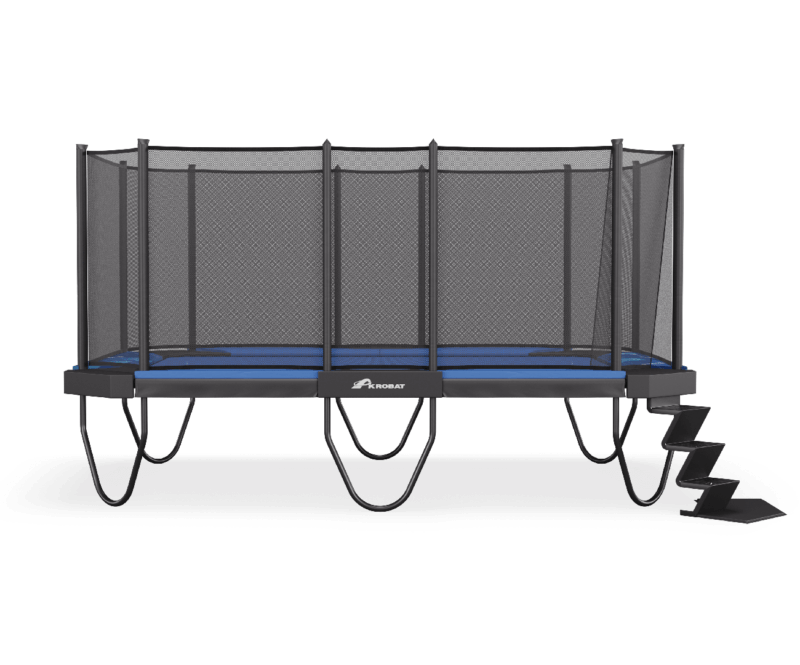
Product Featured -> XCITYX 17ft x 12ft Akrobat Above Ground Trampoline – Printed Blue Pad and Blue Jump Mat
Installation: Differences You Must Know
Above-Ground Setup: Tool-Free & Weekend Ready
Above-ground trampolines are far more DIY-friendly. With Akrobat’s AkroCLICK® tool-free design, you can assemble the frame without screws or special tools, most customers finish the job in a single weekend. There’s no digging, and no complicated planning. That’s part of what makes these models a great fit for families who want flexibility and speed.
In-Ground Setup: Plan for Drainage
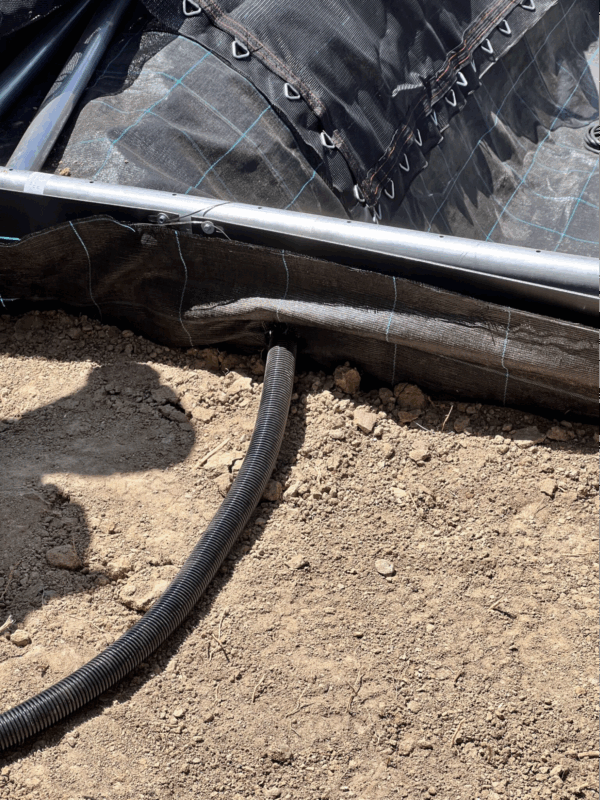
Installing an in-ground trampoline isn’t difficult, but it does demand planning. You’ll need to:
- Excavate a pit deep enough for the galvanized steel frame
- Ensure proper drainage, especially in clay soil or rainy climates
- Use a weed barrier and compacted backfill to support the structure and prevent erosion
- Reinforce with PVC or concrete, depending on soil type and depth
Skip these steps, and you might end up with stagnant water, rusted springs, or a trampoline pit that becomes a breeding ground for mosquitoes. We’ve seen it happen, and fixing it often costs more than doing it right the first time.
Helpful Resource -> In-Ground Trampoline Installation
Can You Convert an Above-Ground into an In-Ground?
In theory, yes. In practice, it’s one of the biggest mistakes we see homeowners make. Standard above-ground trampolines aren’t built for buried conditions. They lack airflow solutions, corrosion resistance, and structural reinforcement needed for ground contact.
The result? Poor bounce, trapped moisture, rusted-out frames, and mats that fail far earlier than expected. That’s why we always recommend choosing an inground-specific trampoline if you’re going that route. Akrobat designed models specifically for ground installation, with airflow-optimized mats, reinforced frames, and engineered drainage solutions that hold up for years.
Maintenance & Durability
Above-Ground Models Are Easier to Maintain
When it comes to upkeep, above-ground trampolines are the more flexible option. Replacement parts, whether it’s the jump mat, safety pads, or springs, are easier to access and install. If a spring wears out or a mat tears, you’re back in business within minutes, not days.
Portability also plays a major role. If a storm is rolling in or you’re doing lawn work, the trampoline can be disassembled and moved without heavy equipment. That flexibility offers peace of mind in regions where seasonal weather can take a toll.
In-Ground Maintenance = Hidden Hassles
With in-ground trampolines, maintenance requires more effort and forethought. Leaves, moisture, and insects tend to collect in the pit, and cleaning out debris isn’t as easy as sweeping underneath. Without a weed barrier or proper grading, mold and plant growth can also become issues.
More seriously, the structural pit itself can shift or collapse if the edges aren’t reinforced. We’ve seen pits begin to sink or erode after a year, especially when clay soil expands and contracts with seasonal moisture. This leads to sagging, uneven mats and extra strain on the galvanized steel frame. It’s not a deal-breaker, but it’s something to factor in if you’re planning the install on your own.
Weather & Wind Resistance
Here’s where in-ground trampolines truly shine. Being set into the earth, they are naturally shielded from wind uplift. For families in hurricane-prone zones or open areas with high gusts, this is a real benefit, no need for tie-downs, weights, or post-storm retrieval missions.
Above-ground models, however, must be anchored or staked. Even then, they’re vulnerable to movement in extreme weather. We recommend removing the safety net and padding during winter or high-wind conditions to prolong the life of the components.
Aesthetics, Landscaping & HOA Considerations
One of the biggest appeals of in-ground trampolines is how seamlessly they integrate with the landscape. You won’t see a steel frame or safety enclosure towering over your backyard, just a clean, flush surface that disappears into the lawn.
For families in HOA-regulated neighborhoods, this is often the deciding factor.
From a landscaping perspective, in-ground trampolines offer creative flexibility. Whether you’re designing a modern garden, a minimalist lawn, or a full backyard play zone, these trampolines don’t disrupt the visual balance. They fit in.
In contrast, above-ground models are functional and flexible, but not subtle. That black or steel frame will always stand out unless you build fencing or screens around it, which adds to cost and labor.
Long-Term Costs & Value
Yes, in-ground trampolines cost more upfront. The trampoline itself might be similarly priced, but digging, drainage systems, soil removal, and framing reinforcement add to the investment.
But when done right, that investment pays off. You’ll get a trampoline that resists wind damage, blends beautifully into your space, and stays put for years, making it ideal for families planning to stay long-term. You also minimize wear-and-tear from storms and UV exposure.
Above-ground trampolines are the opposite: affordable, quick, and lower risk at the point of purchase. If you’re renting, planning to move, or just testing whether trampolining is right for your family, this path offers an easy out. They’re also easier to sell or repurpose once your needs change.
Expert Tips to Choose the Right Trampoline for Your Needs
When helping families choose the right trampoline, we always start with how they plan to use it. Your needs, and your yard, will tell you everything you need to know.
- Have small kids? An in-ground trampoline is the easiest and safest for them to access on their own. If you prefer an above-ground model, make sure you pair it with a low-profile ladder and safety net for added peace of mind.
- Have active teens or athletes? Choose either an in ground or above-ground trampoline with a performance-oriented setup. The higher bounce, enhanced airflow, and rectangular frame options are great for flips, training, and progression.
- Live in a storm-prone area? Go in-ground. It offers better wind resistance and doesn’t require tie-down kits or post-storm repositioning.
- Need portability or rental flexibility? An above-ground model is the way to go. It’s easier to move, resell, or take with you when life changes.
- Want clean landscaping or have strict HOA rules? An in-ground trampoline will integrate smoothly with your outdoor space and minimize visual disruption.
There’s no one-size-fits-all answer. The key is matching your trampoline to how, and where, you’ll actually use it.
Last Shot: Which Trampoline Is Right for You?
Here’s the simple truth: both in-ground and above-ground trampolines can be amazing choices, if they’re matched to your goals, lifestyle, and backyard conditions.
Choose an In-Ground Trampoline If:
- You want a clean, landscaped look
- You’re staying in your home long-term
- You value lower fall height for kids’ safety
- You live in a high-wind or HOA-regulated area
Shop our In-Ground Trampolines:
Choose an Above-Ground Trampoline If:
- You want to install it this weekend
- You need flexibility or resale options
- You’re working with a tighter budget
Shop Our Above-Ground Trampolines
Whichever path you take, quality matters. The springs, the frame, the mat, all of it impacts your experience. At AkrobatUSA, we explain every detail to outperform expectations and withstand real-world use. Because in our world, bounce isn’t just bounce, it’s the foundation for fun, safety, and memories that last.
Ready for the Trampoline That Fits Your Life?
Whether you’re looking for a seamless, safe, and quiet in-ground experience, or want to unlock serious bounce without a single bolt or wrench, we’ve got a solution that fits.
✔️ Solutions Built to Match Your Goals
- In-Ground Trampolines with AkroVENT® Mat Technology: Perfect for families who want a clean look, easier access for young kids, and a softer bounce with maximum airflow. No more “dead bounce”, just smooth, consistent jumps with reduced joint impact.
- Above-Ground Trampolines with AkroCLICK® Tool-Free Setup: Ideal if you need flexibility, fast installation, or high bounce performance for flips, tricks, and teens who never stop moving. Our heavy-duty galvanized steel frames and spring systems outlast anything you’ll find in big box stores.
- All-Weather Safety & Durability Engineering: From wind-resistant in-ground builds to UV-protected padding and rust-proof frames, our trampolines are built for real-world use, not showroom floors.
👉 Compare in-ground and above-ground trampolines at AkrobatUSA
