
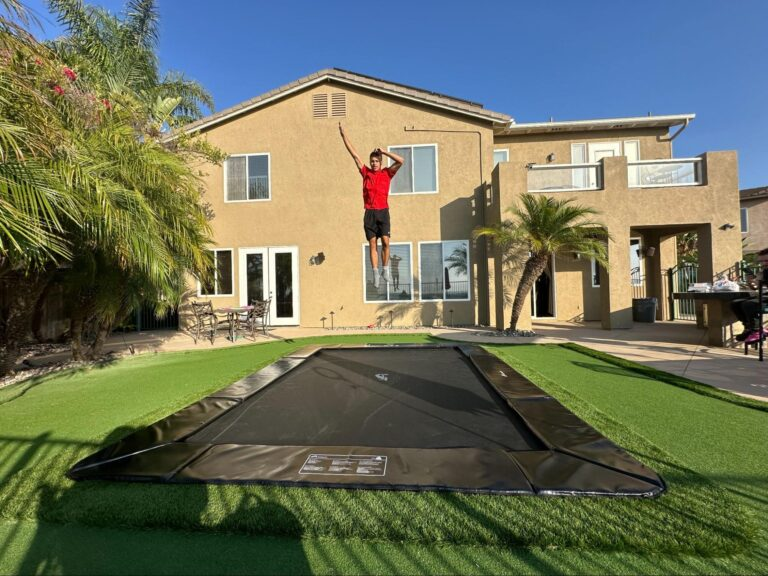
Competitive trampolining requires 10 skills judged on execution, difficulty, flight time, and stability. Recreational rules focus on safety: single jumpers, proper setup, and equipment like Akrobat’s in-ground trampolines. Akrobat USA explains both in clear, simple steps.
If you’re wondering what the rules for trampolining are, whether you’re eyeing Olympic-level competition or simply want your kids to jump safely in the backyard, here’s the answer:
But understanding the rules is only half the equation. The real question is: how do you ensure safety, performance, and long-term durability whether you’re training for elite competition or outfitting your backyard?
At AkrobatUSA, we’ve dedicated over 20 years to perfecting this answer.

If all you needed was the answer, you have it. But if you want to dig deeper into how trampolining rules work, why they matter, and how AkrobatUSA products solve real-world challenges faced by athletes and parents alike, keep reading. You’ll see why doing things right isn’t a marketing slogan for us, it’s simply how we work.
What Are the Rules of Trampolining?
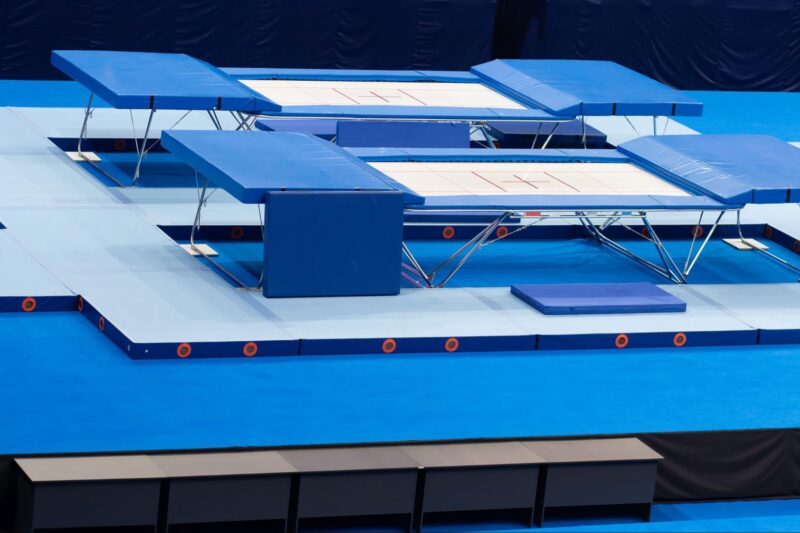
Trampolining operates on two very distinct tracks:
- Competitive sport
- Recreational activity.
Each has its own rules, but both exist to keep athletes and families safer while maximizing performance.
At its core, trampolining, whether performed at the Olympic level or in your backyard, is about control. The rules are there to ensure that every jump, every twist, every landing occurs within safe boundaries. Without strict structure, even a small miscalculation at height can become dangerous. Rules aren’t limitations; they’re what make long-term progress possible.
Since its official inclusion as an Olympic sport in 2000 under the International Gymnastics Federation (FIG), trampolining has grown rapidly worldwide. What began as a specialized gymnastics discipline now commands global audiences, complex judging systems, and some of the most physically and mentally demanding routines in all of sport.
Is Trampolining a Competitive Sport?
Yes, and at the highest levels, it’s nothing short of breathtaking. Athletes compete in several competitive categories, each with its own specialized format:
- Individual Trampoline, The most recognized form, where gymnasts perform 10 consecutive aerial skills.
- Synchronized Trampoline, Two athletes execute identical routines in perfect harmony, judged on timing and synchronization.
- Double Mini-Trampoline, Athletes sprint onto a sloped trampoline, launch into aerial skills, and dismount onto padded mats.
- Tumbling, High-speed passes down a 25-meter spring track, featuring multiple flips and twists without a trampoline bed.
Athletes are classified into three age levels: Youth (under 14), Juniors (14-17), and Seniors (18+). While age divisions exist, make no mistake: success requires years of technical training and mental resilience regardless of category.
What Is Competitive Trampolining?
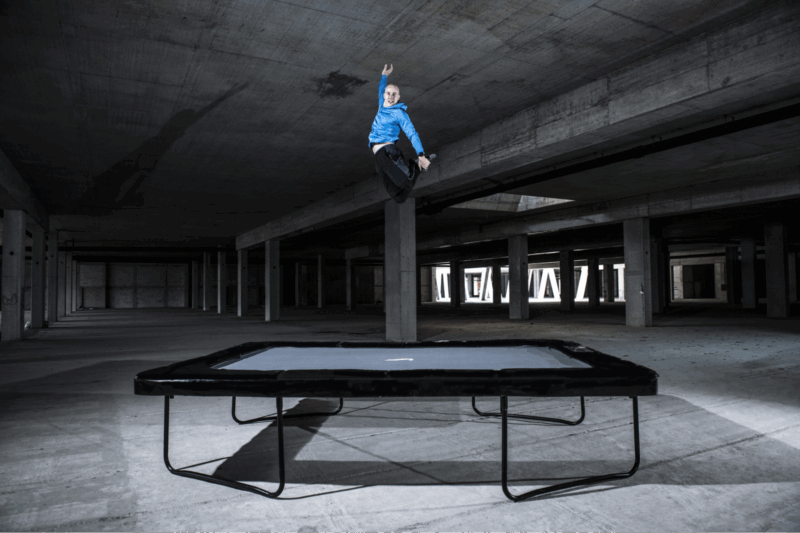
Featured Product 👉 Akrobat Landing Mats
Routine Structure
At the heart of competitive trampolining lies the routine: a sequence of 10 skills performed without interruption. Each skill begins and ends with a specific landing, on the feet, seat, back, or front, with athletes required to maintain full control throughout.
Competitions include two types of routines:
- Compulsory routines: Predetermined skills that test baseline proficiency.
- Optional routines: Freestyle selections that allow athletes to showcase advanced techniques and higher difficulty.
Scoring Breakdown
Competitive scoring is highly technical, combining multiple judging elements:
- Difficulty (D): The complexity of twists, somersaults, and combinations.
- Execution (E): Precision of body control, stability, and technique.
- Horizontal Displacement (HD): How well the athlete stays centered on the trampoline bed.
- Time of Flight (ToF): The total airtime accumulated over all 10 skills.
- Synchronization (SYN): Applied in synchronized events, measuring timing alignment between paired athletes.
Judging & Fault Deductions
Small mistakes can carry large consequences. Common deductions include:
- Hands touching the bed: 0.4 points
- Landing on hands and knees: 0.5 points
- Failing to land with feet together: 0.3 points
In every routine, trained spotters stand at the trampoline’s edge with padded mats, ready to intervene if an athlete loses control. Their role is non-negotiable: to prevent serious injury in moments when precision fails.
Equipment Specifications
Olympic trampolines are engineered for maximum rebound and control. Each measures approximately 5 meters long by 3 meters wide, with a tightly woven bed and finely calibrated springs to generate enormous lift. However, not all trampoline beds feel the same. Stiffness can vary between units, even within the same competition venue, forcing athletes to adjust timing on the fly. Spring tightness, airflow design, and even subtle frame flexion affect how the bed responds at elite levels.
At Akrobat, we’ve obsessed over these nuances. Our AkroVENT® airflow technology and AkroSPRING® system were engineered specifically to reduce harsh landings, improve joint protection, and create consistent bounce characteristics across every jump.
Mental Challenges in Competitive Trampolining
Beyond physical skill, competitive trampolining demands extraordinary mental discipline. Learning twisting skills takes years, often longer than athletes anticipate. The fear of “getting lost in the air” mid-skill, especially during twisting rotations, is a persistent challenge even for experienced gymnasts.
Long-term mental blocks can derail progress. Athletes report needing months to overcome psychological barriers after a frightening misstep in mid-air. This is why safety falls are drilled from an early age: athletes are taught to flatten their bodies and absorb impact across a wide surface, minimizing injury risk when disoriented.
In competition, over-rotation is often safer than under-rotation. Landing short risks head and neck injuries, while slightly over-rotating allows athletes to adjust safely. This delicate balance is why consistency, preparation, and the right equipment become non-negotiable for long-term success.
Recreational Trampolining Rules: Backyard Jumping
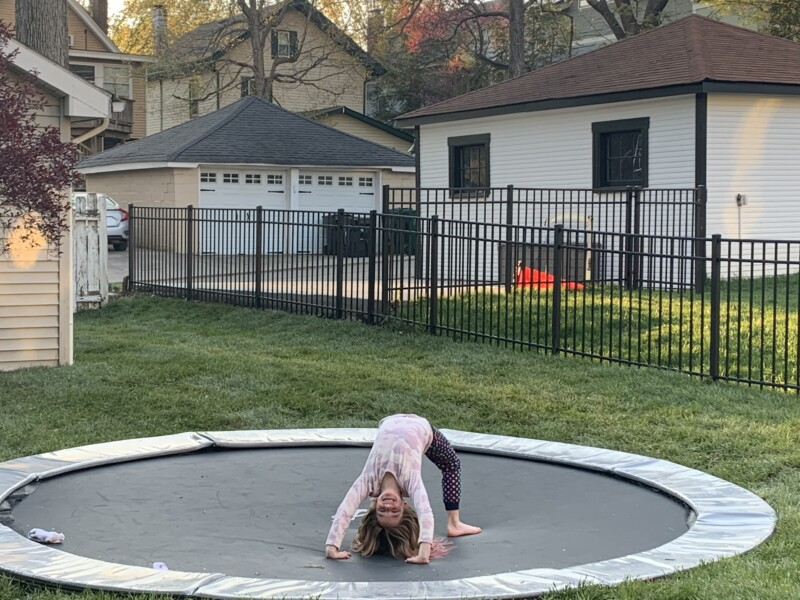
Check out the 12ft Round Akrobat Primus Flat In-Ground Trampoline – Anthracite Grey (Grey Pad and Black Jump Mat) from the photo.
While competitive trampolining captures headlines, most families engage with trampolines in the backyard. The stakes are different, but the need for safety is identical. Recreational rules exist not just to prevent injury but to allow children and adults to build confidence, coordination, and lasting memories.
House Rules for Backyard Safety
- One jumper at a time: Most injuries occur when multiple people bounce together, increasing the risk of accidental collisions and unpredictable bounce heights.
- No flips or somersaults without professional training: Rotational skills demand specific air-awareness training. Attempting flips without proper instruction increases injury risk.
- Parental supervision: An adult should always be nearby when children are jumping, not only to monitor safe behavior but to respond quickly if a fall occurs.
These aren’t arbitrary suggestions, they’re the difference between years of safe enjoyment and one bad landing.
Akrobat’s Trampoline Design
Akrobat approaches recreational trampolining with the same level of technical rigor applied to competitive design. Our goal is simple: deliver professional-grade safety for every family.
- In-ground trampolines lower fall height: Unlike raised models, in-ground installations minimize drop distance, making accidental falls far less severe.
- AkroVENT® airflow jump mats: Engineered for optimal air permeability, these mats deliver consistent bounce softness while protecting joints and reducing harsh landings.
- AkroSPRING® system: Specially designed springs create smoother bounce transitions, allowing children to jump comfortably without sharp recoil forces.
- AkroCLICK® assembly system: Our screw-free, tool-free design simplifies installation and eliminates common DIY assembly risks that can compromise safety.
When you combine lower risk, smoother bounce dynamics, and hassle-free setup, you create an environment where families can truly relax.
Pets & Backyard Trampolines
We often hear from customers about pets joining the backyard fun. While heartwarming, pets require their own set of precautions:
- Supervise animals around active jumpers: Unexpected movements from pets can interfere with jumping patterns and cause sudden imbalance.
- Avoid collars during jumping: Collars can catch on frames or enclosure nets, creating choking hazards.
- Gradual exposure for anxious pets: Some dogs react anxiously to trampoline movement. Introduce them slowly, allowing them to observe from a distance before joining nearby.
By treating trampolines as managed environments, for both kids and pets, you protect every member of the family.
Why Choose Akrobat USA for Trampolines?
We approach trampoline manufacturing with an obsession for quality. Akrobat trampolines are not mass-produced, commodity-grade units. They are European-engineered systems designed for years of safe, consistent, confidence-building use.
- Premium European manufacturing ensures structural integrity, material safety, and long-lasting performance.
- Safety-first design incorporates technologies like AkroVENT® airflow and AkroSPRING® systems that reduce joint stress while maximizing control.
- Built for multiple use cases, from backyard play to serious athletic training and adaptive rehabilitation programs.
When you invest in AkrobatUSA, you’re not buying a temporary toy. You’re installing a platform that supports athletic progression, family enjoyment, and physical health for years to come.
If you’re ready to bring professional-grade safety to your backyard, contact AkrobatUSA. We’re ready to help you make it happen.
