
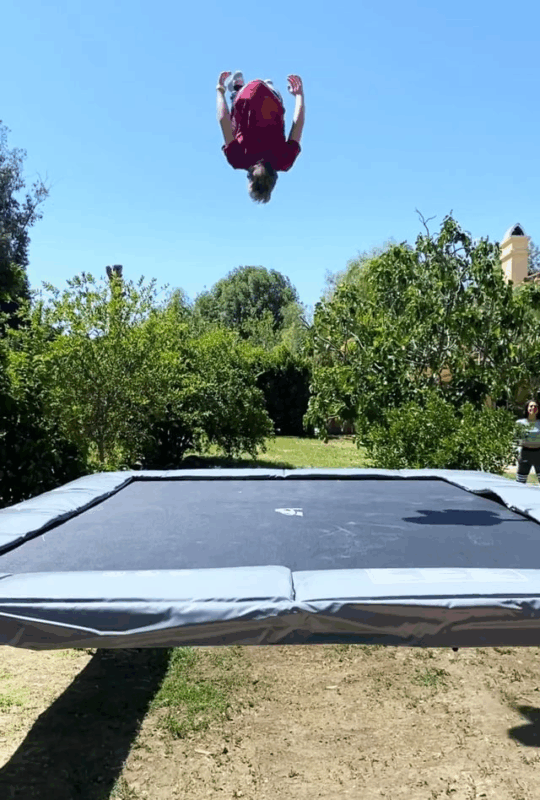
Learning gymnastics on a trampoline is about control, body awareness, and building skills the right way, safely and progressively.
Discover beginner to advanced trampoline tricks, training tips and common mistakes. We cover everything from flips to flexibility, plus how trampolines support real gymnastics goals.
Whether you’re an aspiring gymnast, a backyard daredevil, or a coach helping someone level up their training, the trampoline can be one of the most versatile training tools available.
Here we’ll walk you through:
- What to practice
- How to stay safe
- Which gear makes the biggest difference
- How to train smart, especially if you’re doing this at home.
So that you can do gymnastics on your trampoline like this.
Are Trampolines Good for Gymnastics?
When used correctly, trampolines are one of the most effective tools for developing gymnastic skills. They offer a forgiving surface, allow for longer airtime, and give jumpers the chance to repeat movements without the hard landings typical of traditional gymnastics floors.
Trampolines Build Coordination and Air Awareness
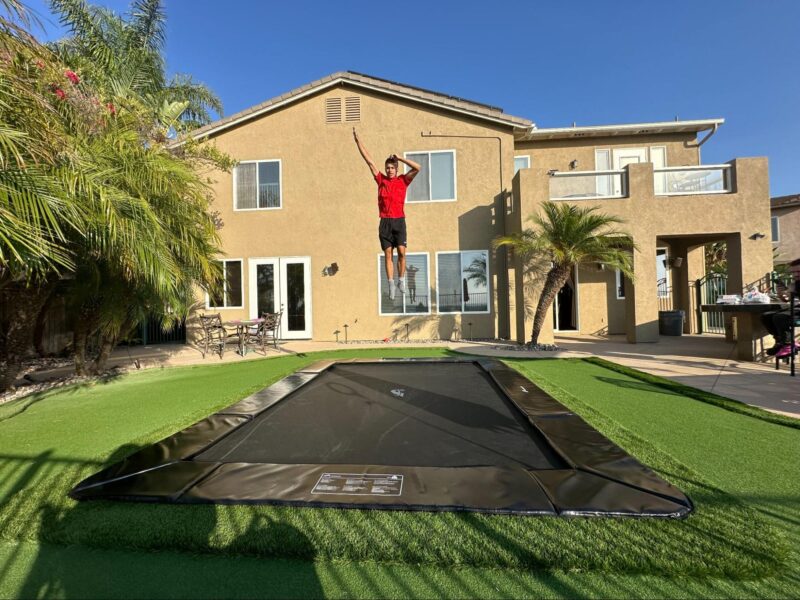
Jumping on a trampoline challenges your balance, posture, and reflexes, every single bounce. That repetitive vertical movement trains the vestibular system (which controls balance) and helps athletes fine-tune their timing.
For gymnasts, this is foundational. Spatial awareness, or “air sense,” is what lets you control your body mid-flip. Trampolines offer the airtime and bounce needed to train that safely and consistently.
Trampoline Gymnastics vs. Artistic Gymnastics
While artistic gymnastics includes events like floor, bars, vault, and beam, trampoline gymnastics focuses exclusively on aerial skills performed on a trampoline.
At the Olympic level, athletes execute ten linked skills in a routine, judged by form, execution, height, and stability. Unlike artistic gymnastics, there are no apparatus transitions, only air-based precision. And because trampolines absorb force, the impact on joints is significantly reduced, making it a popular option for athletes looking for lower-impact training.
Basic Gymnastics Tricks You Can Do on a Trampoline
Basic Bounce: Where All Gymnastics Begins
The most advanced routines still rely on mastering the basic bounce. With knees slightly bent, arms steady, and posture upright, this controlled motion teaches timing and alignment. It’s not about how high you go, it’s about how consistently you can land in the same spot with control.
Seat Drop & Pike Jump: Control + Flexibility
The seat drop involves landing in a seated position, legs straight, and then rebounding back to your feet. It improves coordination, especially for younger jumpers, while the pike jump (legs together and extended in front of you mid-air) starts to stretch hamstrings and test control. Both are low-risk but deeply effective.
Why Beginners Should Ignore Flashy Tricks (For Now)
There’s a temptation to jump straight to flips, but consistency wins. A clean, balanced pike jump repeated ten times does more for your long-term progress than one lucky backflip. And when you use trampolines like ours, engineered for softer bounce and responsive lift, you get feedback with every jump. That feedback teaches discipline.
Beginner Questions, Answered
“Can You Do Real Gymnastics on a Backyard Trampoline?”
Yes, if you take it seriously. While backyard trampolines aren’t competition platforms, the right design and setup can absolutely support skill development. Choose models with:
- Even tensioned spring systems
- High-lift mat response
- Durable, joint-friendly bounce
“Do I Need Coaching, or Can I Teach Myself?”
Having a coach speeds up progress, but it’s not your only option. Solo learners should:
- Use safety tools like crash mats and spotting belts
- Practice in front of mirrors or record video for feedback
- Follow structured progressions: no skipping steps
And never train flips without a safety mat. Even with our soft-landing mats, beginners must protect their neck, spine, and ankles while building technique.
Intermediate Skills to Build Control
Tuck Jump & Straddle Jump: Air Form + Strength
Tuck jumps build core control by driving knees to chest and engaging your abs throughout the motion. The straddle jump takes it further, splitting legs in a “V” mid-air to stretch hamstrings and test posture. These two skills transition well into flipping techniques later on.
Side Flips: Rotational Intro Without the Risk
A side flip is the first real introduction to twisting in the air. Unlike a backflip or front flip, the side flip keeps your vision on the trampoline longer, which helps beginners maintain orientation. When done right, it looks clean and feels controlled, especially when practiced on responsive mats like AkroVENT®.
Advanced Gymnastics Moves on a Trampoline
Full Twist & Barani Flip: Precision in Motion
The full twist is a full 360° body rotation while airborne, requiring tight core activation and stable takeoff. The Barani flip, half twist + front flip, is a favorite among intermediate and advanced gymnasts. It’s technical and forces clean form. These are the tricks that reward body control over brute strength.
Back Handspring on a Trampoline
Taking a floor back handspring to a trampoline allows athletes to master form with less impact on the wrists and spine. It’s a great way to condition for the floor version reducing risk. But even on a soft mat, this move demands spotting or safety gear when first learning.
Tools That Help You Train Smarter
Harnesses with pulleys and spotting belts help reduce fear and keep you safe while learning new skills. They slow down the rotation and give coaches (or spotters) control over your descent. If you’re training without a coach, film yourself or work with online feedback platforms to correct form early.
Worried you’re doing a trick wrong? Start with crash mats. Record your jumps. Watch your landings. There’s no fast track, but there is a smart one.
How Trampoline Gymnastics Is Judged (And What to Practice)
In competitive trampoline gymnastics, each routine is composed of 10 consecutive skills performed without pause. Every movement is judged on four metrics:
- Difficulty: the technical complexity of flips and twists
- Execution: how cleanly the skill is performed
- Time of Flight (ToF): how long the athlete remains in the air
- Horizontal Displacement: how centered the athlete stays on the trampoline bed
The highest-level gymnasts make it look effortless, because they’ve mastered rhythm, control, and consistent landings. But every competitor starts with foundational moves and works their way up.
Why Simpler Isn’t Slower, It’s Smarter
In gymnastics judging, consistency outranks flash. A smooth tuck jump with zero drift scores better than a rushed double flip with off-center landings. Form beats flair. For those training at home, this means focusing on stability before experimenting with power moves.
To train this effectively, we recommend using a high-performance mat like the AkroVENT® jump surface.
Its airflow-enhancing design lets jumpers stay airborne longer, giving athletes more time to set their body and correct their posture mid-air. More time means more control. More control means better scores.
What’s the Hardest Trampoline Gymnastics Trick?
The Top-End Skills: Barani, Double Full, Triffis
- Barani Flip: A front somersault with a half-twist. It’s tricky because it forces mid-air reorientation.
- Double Full: A double-twisting back somersault. Requires explosive lift and laser-tight form.
- Triffis: Three front flips with a half-twist. A skill only attempted by world-class trampolinists.
Each of these skills demands perfect timing, strength, and control. They’re not just physically difficult, they require deep spatial awareness.
The Real Secret: Don’t Rush the Timeline
The biggest risk in trampoline gymnastics? Skipping foundational steps. Most injuries happen when jumpers attempt advanced skills too early, without a proper bounce rhythm or landing control. Training belts, smart mats, and repetition will get you there, safely.
If you’re on an Akrobat trampoline, you’re already a step ahead. Our competition-grade bounce surface gives you more air time and a quieter, smoother experience to hone your technique without distractions or hard impacts.
Advanced Tips to Train Like a Gymnast on a Trampoline
Creating a personal trampoline routine isn’t about copying elite athletes, it’s about sequencing moves that match your current ability and stretch your potential. Start by selecting skills from three categories:
- Foundational (basic bounce, tuck jump, pike jump)
- Transitional (straddle jump, seat drop, side flip)
- Advanced (Barani, full twist, back handspring)
Structure the routine with one skill flowing smoothly into the next. Avoid tricks that interrupt momentum or require awkward resets. You’re aiming for connection, not just completion.
Elevate Your Air Awareness
Aerial awareness is what separates gymnasts from jumpers. Improve it by alternating your flip directions, front, back, twist, so your body learns to orient in multiple positions. Practice spotting: pick a reference point on the ground or wall and track it as you move. Controlled breathing also helps stabilize your motion mid-air. When your breath is off, your balance usually follows.
Rhythm > Power
It’s easy to over-focus on jump height or speed, but rhythm matters more. Gymnasts train to land softly and rebound smoothly. That rhythm creates the setup for the next skill. Break the rhythm, and your whole sequence unravels. Power is useful, but only when it’s guided by timing.
Real Athlete Use Cases (Gymnastics, Recovery, Freestyle)
Gymnasts Who Shifted to Trampoline for Joint Relief
We’ve worked with countless gymnasts who came from traditional artistic programs but faced chronic pain from harsh landings. Trampoline training gave them a new way to pursue flips, twists, and aerial skills, without sacrificing their knees, ankles, or long-term mobility. Trampolines, particularly those with high-quality mat and spring systems, are a second chance for athletes who want to keep going without setbacks.
Aerialists and Divers: Perfecting Air Control Off-Season
Cirque-level aerialists and competitive divers use trampolines to simulate complex mid-air moves before translating them to their discipline. Divers use them to drill twist form. Trapeze artists use them to rehearse tempo transitions and practice falling mechanics. In each case, the trampoline acts like a rehearsal stage, safe, repeatable, and highly responsive.
Adaptive Athletes: Resilience in Motion
Trampolines are increasingly used in rehabilitation settings, especially for paraplegic athletes and those recovering from lower-body injuries. The soft rebound supports strength training without harsh impact. We’ve seen athletes rebuild confidence and coordination by bouncing at their own pace, often for the first time since their injury.
Safety Checklist: Don’t Jump Until You Read This
1. Check Mats, Springs, and Frame Integrity
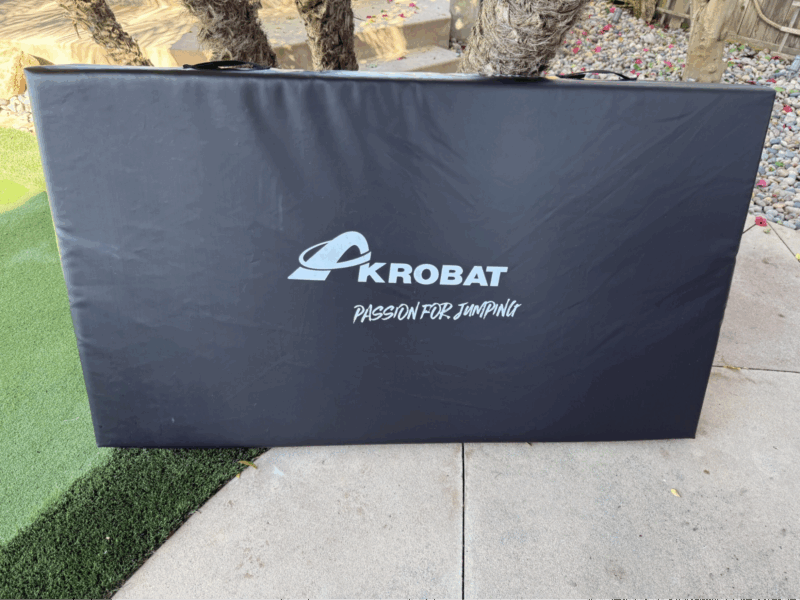
🛒Shop Akrobat’s Landing Mats As Seen In Picture Here
Before every session, inspect your trampoline for:
- Worn or stretched springs
- Torn jump mat threads or discoloration
- Loose padding or exposed metal
Even the best routines fall apart on faulty gear.
2. Weather and Seasonal Care
Snow and heavy rain damage mats over time. For long-lasting performance:
- Use a trampoline cover during the off-season
- Avoid jumping on wet mats
- If in-ground, ensure your pit has proper drainage to prevent pooling
Helpful Resource -> What To Do With Trampoline In Winter
3. Enclosures = Safety, Especially for Kids
Enclosures aren’t just a precaution, they’re a necessity if children are jumping. Even experienced users can misstep mid-trick. A high-quality enclosure helps reduce lateral falls and gives peace of mind when multiple people are around.
4. Simplify Assembly (So It’s Done Right)
Improper setup causes more trampoline accidents than people realize. Our AkroCLICK® system removes screws from the equation. Each part clicks securely into place, reducing errors and giving the trampoline the precise frame strength it was designed for.
Ready to Flip Like a Pro?
The truth is, trampoline gymnastics doesn’t require a gym, a coach, or elite-level status to get started, but it does demand the right approach.
Begin with a stable foundation: build control before complexity, listen to your body, and use gear that helps you progress safely. No skipped steps. No shortcuts.
Akrobat trampolines are built to elevate your performance, safely and consistently. Whether you’re learning your first tuck jump or perfecting a Barani, the right equipment is your best coach.
Why AkrobatUSA Is the Upgrade Serious Jumpers Choose
If your biggest question is how to do gymnastics on a trampoline without plateauing, struggling with injuries, or guessing your way through flips, you need a setup that supports smart training. AkrobatUSA offers:
- AkroVENT® Jump Mats: More airflow, more airtime, less joint strain
- In-Ground and Above-Ground Trampolines: Engineered for rhythm, form, and safety
- AkroCLICK® Assembly: Secure setup, no screws, fewer mistakes during installation
These aren’t box-store trampolines. They’re used by athletes, coaches, and rehab professionals who take every bounce seriously.
Who This Is (and Isn’t) For
This is for you if:
- You want to learn or teach real gymnastics skills at home
- You’re an athlete, coach, or parent who values quality over gimmicks
- You need a trampoline that’s built for long-term, high-volume training
This is not for you if:
- You’re looking for the cheapest option
- You only plan to jump a few times a year
- You’re okay replacing your trampoline every two seasons
What Life Looks Like After the Upgrade
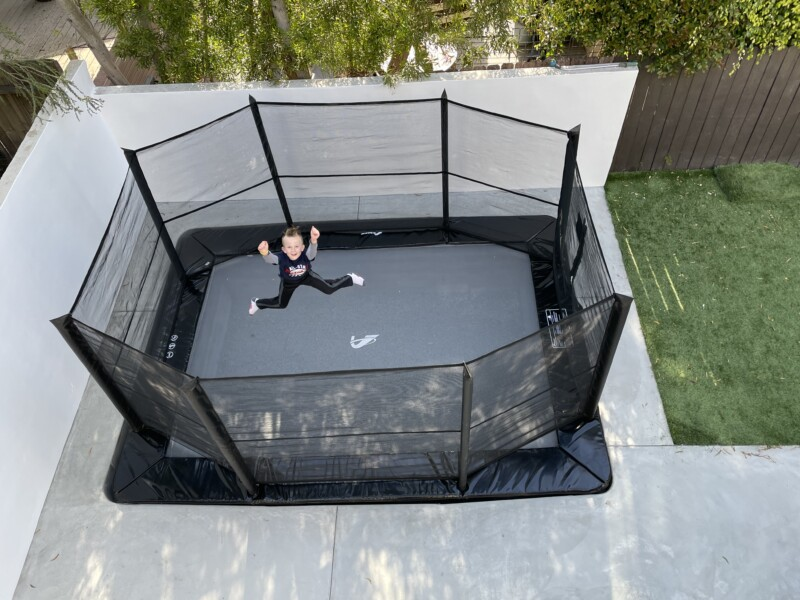
Training gets smoother. Skills come faster. Falls become softer. Whether you’re flipping before breakfast or jumping for recovery, every session on an Akrobat trampoline gives you more bounce, more confidence, and more control. Your trampoline no longer holds you back, it launches you forward.
Explore the Akrobat collection today, designed for gymnasts, jumpers, and athletes who want to train smarter, bounce higher, and land cleaner. Your trampoline shouldn’t just be fun. It should be functional. And it should last.
