
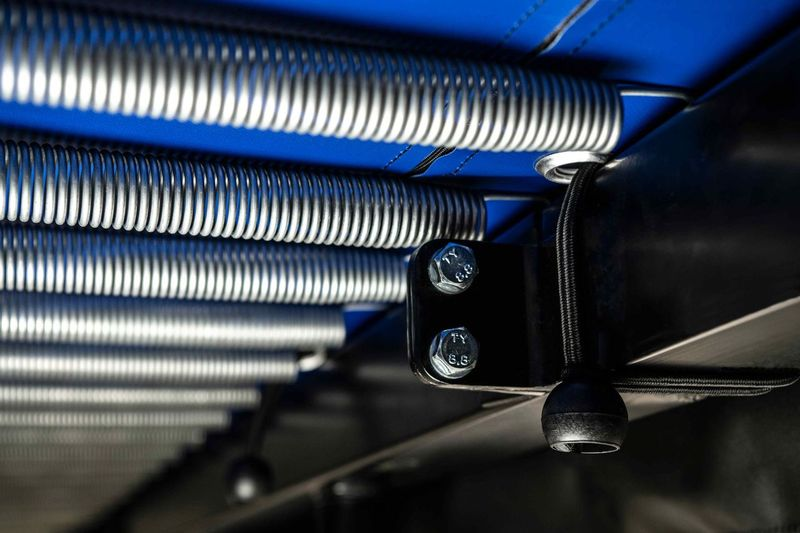
Think of your trampoline springs like the engine under the hood: they determine how high you fly, how softly you land, and how much stress your frame and mat endure with every jump.
In this guide, we’re going to cut through the confusion and give you straight answers.
You’ll learn exactly how spring length impacts trampoline performance, the pros and cons of longer springs, and whether upgrading your springs is really worth it.
How Trampoline Springs Work: The Science Behind the Bounce
If you’re the kind of person who’s always curious about how the world works, this is for you
Springs, Energy, and Hooke’s Law Simplified
Let’s start with the fundamentals. Every time you jump on a trampoline, you’re engaging a simple but powerful principle of physics: Hooke’s Law. It states that the force needed to stretch or compress a spring is directly proportional to how far it’s stretched. In plain English? The harder you jump, the more the springs stretch, and the more energy they store to push you back up.
When you land on the mat, your weight pulls the springs downward, converting your kinetic energy into potential energy stored in the stretched coils. Then, as the springs recoil, that stored energy is released, propelling you upward in the classic trampoline bounce.
But here’s where it gets interesting: the way a spring stretches and returns energy is shaped by the spring’s length, coil thickness, number of coils, and even the steel quality.
The Role of Spring Length in Bounce Quality
So what happens when you compare a long spring to a short one?
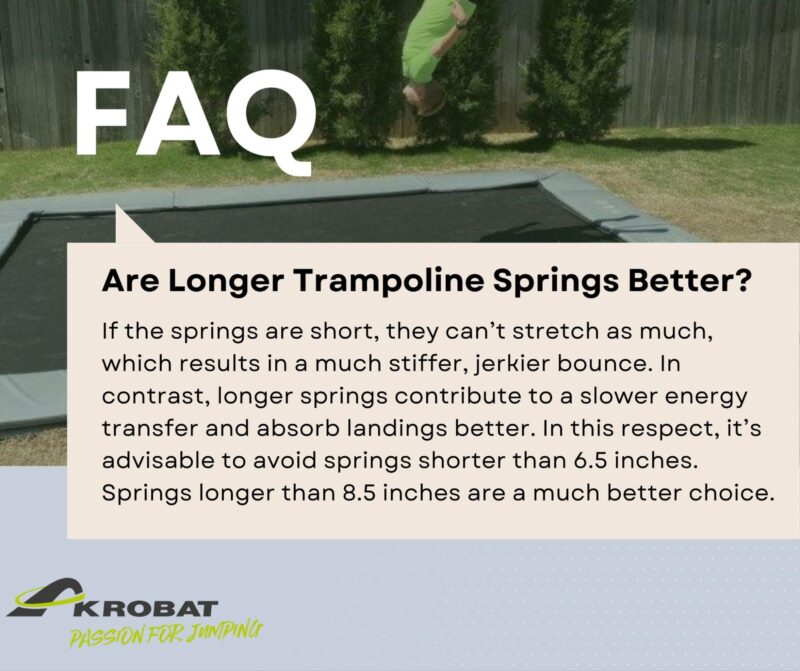
Longer springs stretch farther under the same force, creating a deeper, softer bounce. That extra stretch cushions the landing, reduces jarring impact on your joints, and gives a slower, more controlled rebound.
Shorter springs, on the other hand, recoil faster. They don’t stretch as far, which creates a firmer, snappier bounce that responds quickly to each jump. For smaller kids or casual jumpers who don’t need a lot of “airtime,” a trampoline with shorter springs may actually feel more fun and responsive.
And here’s a question we hear all the time:
“Does a longer spring mean I’ll bounce higher?”
Pros and Cons of Longer Trampoline Springs
It’s not forever sunshines and rainbows (at least for some). Here’s what you need to know about longer springs:
Benefits of Longer Springs
First, longer springs provide softer landings with lower impact on your joints. By stretching farther, they absorb more of the force from each jump, reducing the jarring snapback that can strain knees and ankles, especially for adults or older kids.
Second, longer springs create more “airtime.” If you’re a gymnast, a trick jumper, or just someone who loves the feeling of floating at the top of your jump, you’ll appreciate the way longer springs extend the bounce cycle. That slower, deeper rebound gives you more time in the air and a smoother arc to your jumps.
Finally, longer springs handle heavier users better. The extra stretch distance allows the springs to flex under greater loads without bottoming out, making them ideal for adults.
How Spring Length Affects Safety and Durability
Frame Compatibility: Why You Can’t Just Swap Springs
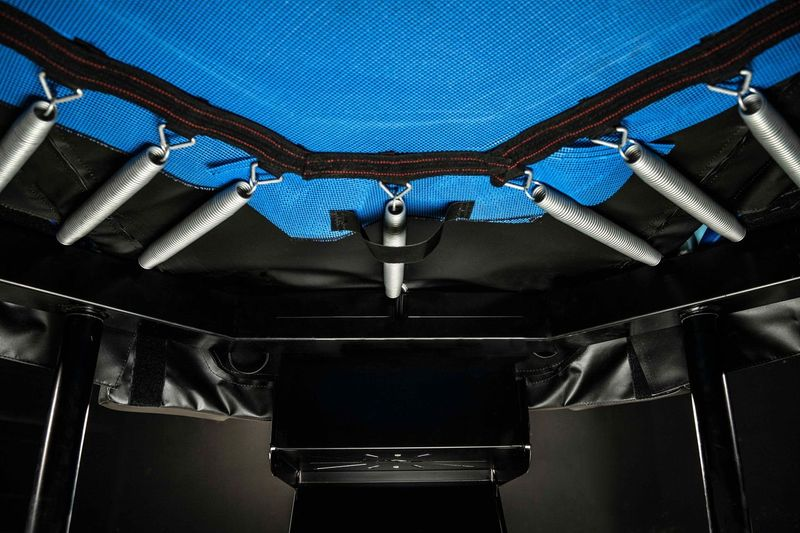
One of the biggest misunderstandings we hear trampoline owners make is assuming that upgrading to longer springs is as simple as swapping them out. We wish it were that easy, your trampoline frame was engineered for a specific spring length, tension, and set up. Change the springs, and you’re changing the forces acting on every part of that frame.
Longer springs exert greater pulling force on the frame’s anchor points because they stretch farther under load. If your frame wasn’t designed to handle that added force, you risk bending the tubing, loosening the welds, or even cracking the joints over time.
Which led to the question:
“Can I upgrade my trampoline by just replacing the springs?”
The honest answer? Only if your frame and mat were designed to handle the increased extension and tension. Otherwise, you’re only creating an imbalance. Not only can a weak frame start to bow or fail, but your mat’s attachment points may not align properly with the longer springs, leading to uneven pull, overstressed stitching, or distorted bounce.
This is why professional trampolines, like those we build, are engineered as complete systems. The spring length, frame strength, mat tension, and even ring spacing work in harmony. You can’t isolate one component without considering its effect on the whole.
Spring Quality & Longevity: Beyond Length
Galvanized steel is key for outdoor trampolines. A proper hot-dip galvanized coating protects against rust, UV degradation, and corrosion from moisture exposure. Springs without this protection may lose elasticity or snap far sooner than expected.
And remember: more coils doesn’t automatically equal better performance. If the steel is thin or poorly tempered, extra coils will simply stretch unevenly or fatigue faster. It’s why we use EU-certified steel meeting EN10305-3 standards to ensure every spring maintains its structural integrity under repeated stress.
Our AkroSPRING® system is rated for 2.5 million jump cycles. That’s a real-world durability benchmark that far exceeds typical backyard trampolines. It’s also why we confidently back our springs with a 10-year warranty, compared to the 1-2 years you’ll see on lower-end models.
Comparing Spring Types: Which Is Right for You?
When people ask us whether longer springs are “better,” our answer is always the same: “Better for what?” Because at the end of the day, the right spring depends on who’s jumping, how they’re using the trampoline, and what kind of experience they want.
Shorter Springs: For Snappy Bounce and Light Jumpers
Shorter springs create a more responsive, quicker bounce. They don’t stretch as far under load, which means they return energy faster. This results in a tighter, more immediate rebound which is good for jumpers who like a lively, springy feel without needing deep deflection.
That’s why shorter springs are usually the better choice for small children or beginner jumpers. Young kids don’t weigh enough to fully stretch longer springs.
Shorter springs also work well for casual backyard use, birthday parties, and family fun. They create a predictable, playful bounce that doesn’t require much strength to enjoy.
Longer Springs: Best For Deeper Bounce and Athletic Use
Now, for gymnasts, trick performers, or older teens who want to push their limits, longer springs are often the better choice. Why? Because they stretch farther, which extends the bounce cycle and creates more “airtime.” That extra deflection gives jumpers a smoother takeoff and more hang time for flips, twists, and advanced maneuvers.
Longer springs also provide softer landings, reducing impact on joints and absorbing force more gradually. For adults, heavier users, or anyone practicing repetitive jumps, this cushioning effect can make a huge difference in comfort and safety.
But (and this is key) longer springs require a stronger frame and properly tensioned mat to work ideally. Without the right structural support, the extra pulling force of those springs can bend frames, overstretch mats, or throw off the trampoline’s engineered balance.
Looking for 8.5-Inch Trampoline Replacement Springs? We Got You
Akrobat’s Approach: Optimized Spring Systems for Balance and Longevity
We’ve learned through decades of engineering that trampoline performance is about how every component works together. That’s why we created the AkroSPRING® system, an integrated spring and mat pairing designed to deliver optimal bounce, safety, and durability as a unified experience.
Unlike generic springs or one-size-fits-all upgrades, AkroSPRING® is calibrated to the exact specifications of each trampoline model. The spring’s length, coil count, wire thickness, and material are engineered in harmony with the mat’s weave, the frame’s strength, and the placement of every connection point.
The result? A bounce that feels powerful, controlled, and joint-friendly. Whether you’re a gymnast, an athletic teen, or a parent jumping alongside the kids.
Another key difference is the proprietary geometry of our springs. We’ve designed them to prevent overstretch, reduce premature fatigue, and maintain a taut, responsive mat without stressing stitching or anchor points. That means fewer issues down the road.
As one of our customers put it:
“I was amazed the bounce stayed consistent after 3 years. It’s not just the spring length, it’s the system.”
That’s what happens when every part is engineered to work together. That’s the Akrobat difference.
👉 If you’re ready to upgrade to a trampoline engineered for durability, optimal bounce, and safety-tested springs, explore Akrobat’s premium trampolines today!
