
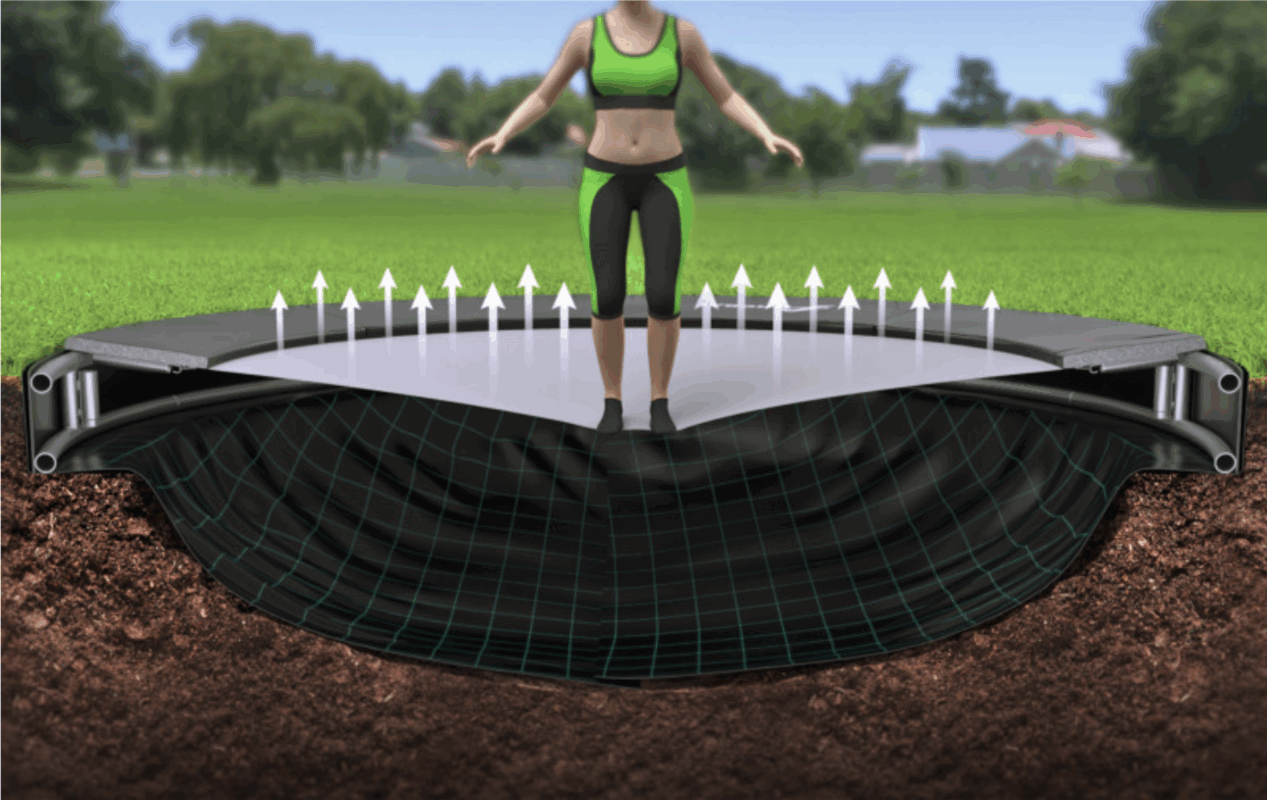
You’ve got a trampoline. You’ve got the yard. You’re dreaming of a sleek, flush-to-the-grass setup where your kids can bounce freely without climbing a ladder or worrying about falling off the edge. Maybe you’ve even seen one buried in a neighbor’s backyard and thought,
“Why not just sink mine into the ground too?”
Let’s slow that thought down.
The short version? Yes, you can put a standard above-ground trampoline in the ground. But should you? We’re going to walk you through exactly why burying a “normal” trampoline will be more headache than it’s worth.
Let’s dig in.
Quick Answer: Yes, But You Probably Shouldn’t
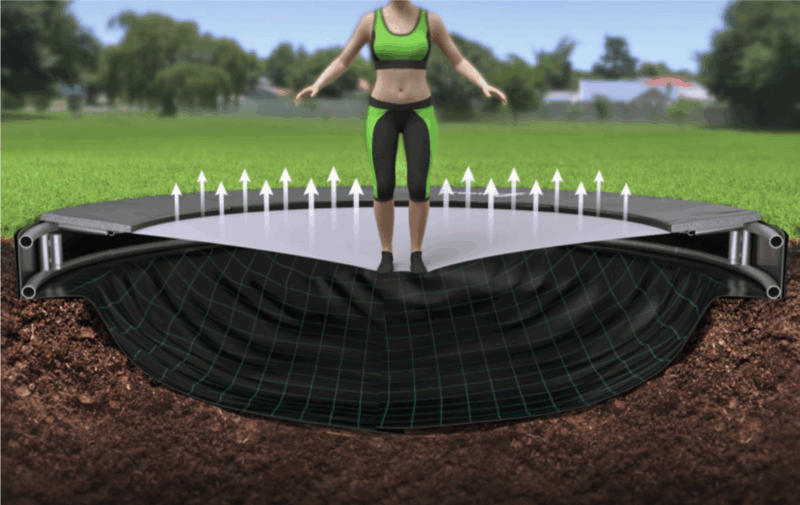
Can you take a regular backyard trampoline and drop it into a hole? Sure. With the right tools, enough time, and a strong back, you can make almost anything happen. But here’s the reality: just because it’s possible doesn’t make it a good idea.
We’ve seen families attempt this dozens of times. They dig the pit, drop in a standard trampoline frame, and hope for the best. Some even manage to get the bounce to feel “okay” by raising the frame an inch or two or experimenting with DIY venting. But nearly all of them run into problems, fast.
What most people underestimate is how much air movement and soil conditions affect bounce and safety. If the hole is too shallow, you bottom out. If there’s no airflow, the bounce feels flat and sluggish. Skip proper drainage? Now you’ve got a trampoline sitting in a muddy basin that’s quietly rusting away.
Worse, burying the legs can cause the springs and frame joints to sit flush with or below the soil line, leaving no room for proper spring compression or ventilation. You’ll also expose sharp hardware and pinch points, turning what should be a fun jumping surface into a potential hazard.
Bottom line: this isn’t just a creative landscaping idea, it’s a structural gamble. And unless you’re prepared to solve for every variable like airflow, moisture, safety padding, and long-term access for maintenance… you’re probably better off not taking the risk.
DIY Reality Check: What It Really Takes to Bury a Trampoline
We get how tempting it is to look at that flat spot in your backyard and think, “This won’t be so bad, I’ve got a shovel, right?” But if you’re seriously considering burying a regular trampoline, let’s talk about what it actually takes to do it safely and properly. Because here’s the truth: most DIY attempts fall short, fast.
You’ll need to…
1. Dig Deep, Really Deep
To bury a mid-size round trampoline, you’re digging a hole at least 3 feet to 4 feet deep. For context, that’s about 15 tons of soil which is enough to fill a 2 commercial-grade dumpsters. This isn’t a Sunday afternoon project. You’ll need a mini excavator, a disposal plan for the dirt, and strong arms (or a few good friends).
2. Plan for Ventilation
You’ll need to integrate vented spring pads, leave intentional gaps, or install DIY air ducts to let air escape as jumpers land. Without it, you’ll destroy your bounce and strain your springs.
3. Build Real Drainage
Water will find its way into your trampoline pit, it’s just a matter of when. Without a gravel base, French drain system, or even a sump pump, that pit becomes a pond. And when water pools under the trampoline, rust shows up fast, bounce disappears, and repairs become a nightmare.
4. Reinforce the Walls
Depending on your soil type, you’ll likely need to reinforce the pit with retaining bricks, PVC paneling, or in some cases, poured concrete. Why? Because over time, the fully excavated soil can collapse inward, cracking your frame or sinking your trampoline unevenly. If you live in an area with sandy or loose soil, this step isn’t optional.
We emphasize this point: you’re not just dropping a trampoline into a hole. You’re creating an engineered system that has to manage airflow, water movement, structural integrity, and long-term safety, all without manufacturer support.
Unless you’re ready to treat this like a backyard construction project, you may end up with more regrets than rebounds.
The 6 Biggest Downsides of Sinking a Standard Trampoline
If you’re still leaning toward digging that hole, it’s key to understand what you’re actually signing up for. Because once that trampoline is underground, you’ve committed to a host of challenges that most people never see coming. Let’s talk about the six biggest downsides, none of which you’ll find on the side of a trampoline box.
1. Bounce Quality Tanks
The very first thing you’ll notice? The bounce doesn’t feel right.
That’s because regular trampolines rely on airflow underneath the mat to function. When you bury the frame in a pit with no ventilation, you trap that air and suddenly, your trampoline feels stiff, flat, or like it’s fighting against you. Without airflow escape, you’re not bouncing, you’re pushing against a pressurized chamber.
2. Major Risk of Rust & Corrosion
Burying a trampoline frame means consistent contact with damp soil. Even galvanized steel can’t hold up under constant moisture exposure, especially when there’s no airflow to keep things dry.
Frames rust. Typical springs corrode. Weld points weaken. And by the time you notice what’s happening, it’s too late.
3. Trampoline Lifespan Shrinks Significantly
Trampolines are an investment. But when you install one in the ground that was never meant to be there, you’re cutting that investment short. What could’ve lasted 8–10 years might only give you 2–3 before corrosion, moisture, and stress take their toll.
Above-ground trampolines can be inspected, maintained, and moved. Once you bury one, you’re working blind and the lifespan shortens with every season.
Helpful Resource -> Should You Get An In-Ground Or Above Ground Trampoline
4. Hard to Move Later
Plans change. Families move. Yards get redesigned.
But once your trampoline is buried, it’s not going anywhere without a full excavation. That’s time, tools, and cost all over again. What started as a “temporary” project becomes a permanent fixture and removing it can be more of a hassle than installing it.
5. Unsafe Spring Exposure
When a trampoline isn’t designed for in-ground use, the springs are often exposed during burial. Soil settles, gaps form, and before long, sharp edges and pinch points are visible around the frame.
It’s a safety hazard especially for small kids who run or play near the edge. Covered springs, soft edges, and sealed designs are all standard on purpose-built in-ground models. But most above-ground units just aren’t equipped to handle this environment safely.
6. More Expensive Than It Seems (Time, Tools, Soil Removal)
The biggest myth? That burying a regular trampoline is the “budget” version of an in-ground setup.
In reality, you’ll likely need:
- A mini digger or excavation crew
- Disposal for 10–15 tons of soil
- Drainage materials like gravel and piping
- Wall reinforcements for the pit
- And possibly replacement parts when things start to corrode
Add it all up, and you may end up spending more than if you’d just bought an actual in-ground trampoline from the start.
Helpful Resource -> How To Install A Trampoline
The Smarter Option: Use a Purpose-Built In-Ground Trampoline
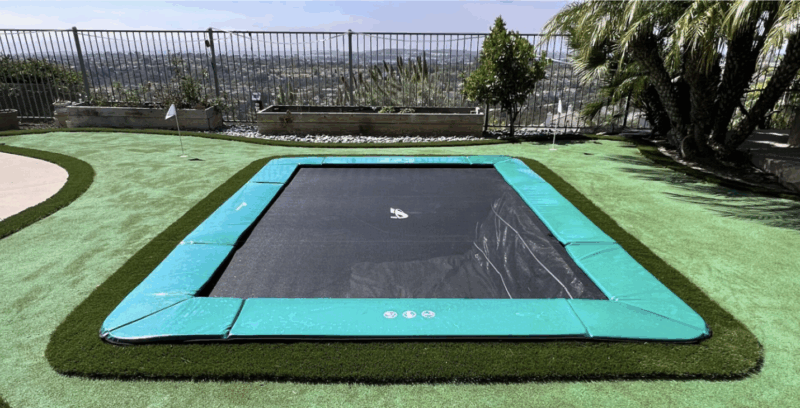
After everything we’ve walked through; airflow issues, rust risks, unpredictable costs, it’s clear that trying to bury a standard trampoline is like forcing a square peg into a round hole. You can make it work, but you’ll spend more time fixing problems than enjoying the results.
That’s why, if you truly want the clean look and accessibility of a sunken trampoline, the smarter route is to choose a system engineered for that purpose from the beginning.
🔗 As seen in the picture → 17ft x 10ft Akrobat Primus Flat Plus In-Ground Trampoline – Green Pad and Black Jump Mat
Why It’s Worth It
We don’t treat trampolines like seasonal toys. We build them the way an architect approaches a high-performance structure; thoughtfully, thoroughly, and with the end user in mind. Our in-ground models are designed from the ground up (literally) to solve all the problems you face when burying a normal trampoline.
Our proprietary AkroVENT® mat technology ensures proper airflow, preserving lift and reducing pressure strain on the springs. And each system comes with drainage guidelines that can be built into the installation, not as an afterthought.
You get a clean, seamless look without compromising the fun or safety. And more above all, you get peace of mind.
Built for Safety & Longevity
Every in-ground trampoline we manufacture is built to perform and built to last:
- Certified to EU Safety Standards: Including EN 1176, EN 913, and EN 71-14, which cover impact safety, material toxicity, and child protection. That’s real-world engineering, not marketing fluff.
- Lifetime Frame Warranty: We’re confident enough in our product to back the core structure for life. When you install an Akrobat, it’s not a seasonal item. It’s a backyard fixture.
- Rust-Resistant Galvanized Steel: Our frames feature hot-dip galvanization with a heavy zinc coating. They’re tough enough to handle anything, from heavy use to harsh weather.
- Tool-Minimum Installation with AkroCLICK®: Our system clicks together with precision, eliminating weak points and making install smooth, even for first-time DIYers.
If your goal is to have a trampoline that looks beautiful, jumps like a dream, and holds up for years with minimal maintenance, this is the way to go. We wouldn’t recommend it otherwise.
Whether you’re installing for your kids, your training, or just some backyard fun, our systems deliver the bounce, safety, and longevity that generic trampolines can’t.
If you’re ready to install a trampoline that actually belongs in the ground, you’ll find it right here.
👉 Explore AkrobatUSA’s In-Ground Trampolines and experience the difference quality makes.
