

If you’re shopping for a trampoline, you’ve probably come across weight limits listed in product descriptions. But what do those numbers mean? As someone who’s spent years in the industry We can tell you this.
Not all weight ratings are created equal.
Trampolines aren’t just about fun. You need to factor in their performance, durability, and safety. The weight limit plays a huge role in determining how well a trampoline will hold up under real-world use.
Can a trampoline break under too much weight? Yes, let me explain.
A cheap trampoline might not snap in half immediately, but over time, its frame can weaken, its springs can lose tension, and its mat can sag—creating a safety hazard. And yet, you’ll see plenty of questionable brands advertising trampolines with “1,500-lb weight limits” when reputable brands cap theirs at 250-350 lbs.
Why?
Those numbers don’t always reflect real jumping conditions.
The Truth About Trampoline Weight Ratings
Here’s what most manufacturers won’t tell you:
- Many brands test trampolines under static conditions—which means they stack weight (like sandbags) onto the mat until it collapses. But trampolines aren’t meant to hold weight like a table; they’re designed to absorb and rebound force.
- In real-world conditions, a 200-lb person jumping can generate 800 lbs of force on impact due to G-forces. That’s why static load testing doesn’t reflect actual performance.
- Cheaper brands cut corners with thin steel frames and weak springs, leading to misleading weight limits that don’t account for dynamic impact.
At Akrobat, we don’t play that game. We engineer trampolines to handle real forces, not just lab tests. Our hot-galvanized steel frames are heavier and stronger than the competition, and our AkroVENT® jump mats absorb 62.7% more energy, reducing impact stress. The result? A trampoline that lasts longer, performs better, and actually holds up to the weight limits we list.
So before you trust an online weight limit claim, ask yourself: Do I want a trampoline that just looks strong on paper, or one that’s built to last?
Let’s dive into what determines a trampoline’s true weight capacity.
Understanding Trampoline Weight Limits: What Really Matters?
If you’ve been browsing trampolines, you’ve likely seen weight limits all over the map—250 lbs, 400 lbs, even 1,500 lbs. But what do those numbers actually mean? As a company who has spent years engineering and testing trampolines, We can tell you that most people misunderstand weight limits, and many brands take advantage of this confusion.
A trampoline’s true weight capacity isn’t just a number—it’s the sum of how the frame, mat, and springs handle real-world jumping conditions. Let’s break it down the right way.
1. Frame Strength: The Foundation of a Durable Trampoline
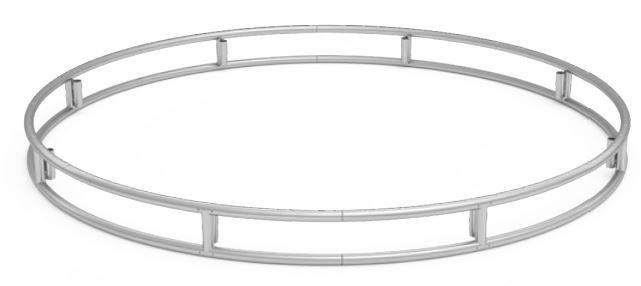
The frame is the single most important factor in determining how much weight a trampoline can handle. If a frame bends or warps, everything else—bounce quality, safety, and longevity—falls apart.
At Akrobat, we use hot-galvanized steel with a 275 g/sqm zinc coating. Why? Because it resists bending under force, doesn’t rust even in harsh weather, and absorbs shock better than the thin, low-grade steel found in budget trampolines. A heavier frame doesn’t just support more weight—it enhances stability and prevents wear and tear over time.
🚨 The problem with cheap frames: Many low-cost trampolines use thin, lightweight steel that flexes under stress. Over time, this can lead to wobbling, uneven bounce, and frame failure—especially under repeated impact.
2. Mat Material & Tension: Why AkroVENT® Outperforms Standard Mats
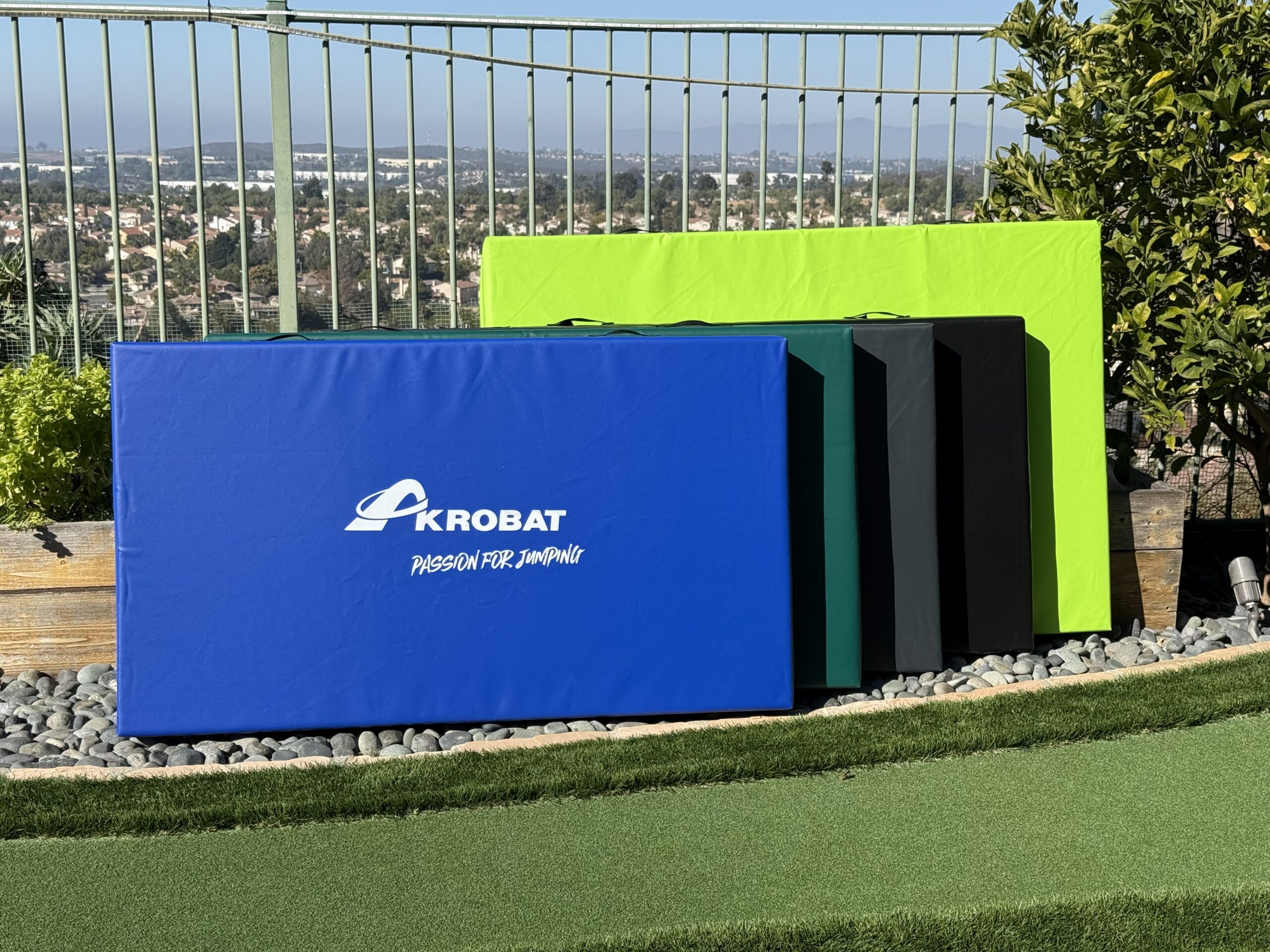
The jumping mat is where all the impact happens, and not all mats are created equal. Most trampolines use polypropylene mats that restrict airflow, limiting bounce efficiency and increasing impact stress on the body.
We engineered the AkroVENT® jump mat to solve this problem. It offers 62.7% better air permeability than standard mats, meaning:
✅ Smoother, higher jumps with less resistance.
✅ Less strain on the mat and frame, extending durability.
✅ More controlled landings, reducing the risk of injury.
🔥 The problem with standard mats: A low-quality mat creates inconsistent bounce, wears out faster, and can rip under repeated stress. If you’re looking for a trampoline that holds up over time, the mat quality matters just as much as the frame.
3. Spring System: Why AkroSPRING® Changes the Game
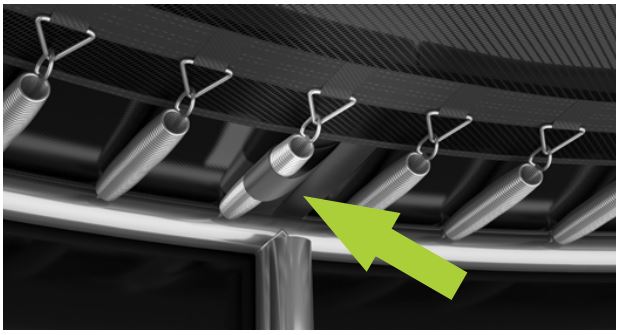
A trampoline’s bounce quality isn’t just about the mat—it’s about how the springs handle force.
Most budget trampolines use short, tightly wound springs that create a stiff, jarring bounce. Over time, these springs lose elasticity, leading to sagging mats and uneven weight distribution.
Akrobat trampolines feature AkroSPRING® technology, which is designed for:
✅ Softer bounce absorption, reducing joint impact.
✅ Optimized energy transfer, creating a smooth, competition-grade rebound.
✅ Long-term durability, preventing sagging even after years of use.
💡 The issue with weak springs: Inferior springs can cause uneven weight distribution, making the trampoline unsafe for multiple users and increasing failure risks under dynamic force.
How Trampoline Weight Limits Are Tested (And Why Some Are Misleading)
Here’s something most trampoline brands don’t tell you. The way weight limits are tested can be completely misleading.
Static Load Testing vs. Real-World Jumping Forces
Many manufacturers determine weight limits by stacking sandbags on the trampoline until the frame collapses. But trampolines aren’t meant to hold weight like a table, they’re designed to absorb and redistribute force.
💥 The reality of dynamic forces:
- A 200-lb person landing from six feet in the air can exert over 800 lbs of force.
- That means a trampoline rated for 1,500 lbs in static testing might not safely support even two adults jumping together.
⚠️ Why it matters: A trampoline built for real dynamic forces—like AkrobatUSA’s—will perform better under actual jumping conditions, not just in a test lab.
Why Do Some Trampolines Claim 1,500 lbs but Only Hold 200lbs?
This is one of the biggest marketing tricks in the trampoline industry. You’ll see trampolines advertised with outrageous weight capacities, but if you check the fine print, things don’t add up.
1️⃣ Structural Weight Capacity vs. Single-User Weight Limit
Many brands list structural capacity—the total load a trampoline frame can hold without collapsing under static conditions. This might be 1,200–1,500 lbs, but that doesn’t mean it’s safe for a single jumper.
The single-user weight limit (typically 200-330 lbs) is what actually matters. It’s the maximum weight a person can safely jump with before performance, safety, and longevity are compromised.
2️⃣ Misleading Weight Limit Tactics
🚩 Marketing trick: Some brands inflate weight limits to look more competitive, but they don’t actually test trampolines under real-world conditions.
🚩 Cheap materials: Many Amazon trampolines list 1,500-lb weight limits, but they’re built with thin steel and weak springs that struggle to handle even 200 lbs of real jumping force.
💡 How to spot a real weight limit: Check the frame thickness, spring quality, and mat construction—not just the advertised number.
What Size & Type of Trampoline Do You Need?
Not all trampolines are built the same, and size plays a major role in bounce quality, weight capacity, and safety. A trampoline that’s too small for a heavier jumper will have a stiffer, less responsive bounce, while a trampoline that’s too large for a young child might be overkill.
Here’s a breakdown of the best trampoline size and type based on user needs.
| User Type | Recommended Trampoline Size | Recommended Weight Limit | Best Option |
| Young Kids | 10-12 ft | 150-250 lbs | Round In-Ground – Safe & low impact |
| Teenagers & Families | 12-15 ft | 220-286 lbs | 14ft x 10ft Primus In-Ground – Versatile, high bounce |
| Athletes, Adults & Gymnastics | 15-17 ft | 250-331 lbs | 17ft x 10ft Primus Challenger – Competition-grade bounce
XCITYX Above-Ground – Large, heavy-duty frame |
In-Ground vs. Above-Ground Trampolines: Which Is Stronger?
One of the biggest decisions when buying a trampoline is choosing between in-ground and above-ground models. Both have advantages, but if you’re considering weight capacity, stability, and long-term durability, the right choice depends on who’s using the trampoline and how.
Let’s break down which trampoline type is best for heavy jumpers, families, and serious athletes.
Is an In-Ground Trampoline Safer for Heavy Jumpers?
If stability and weight capacity are your top concerns, an in-ground trampoline is hard to beat. Because it’s installed flush with the ground, it offers:
✅ Greater structural support – The frame is reinforced by the surrounding soil, preventing wobbling or frame stress.
✅ Lower risk of tipping – Above-ground trampolines can shift under extreme weight loads, but in-ground models stay in place.
✅ Ideal for high-weight users – Adults, gymnasts, and multiple jumpers will experience less frame flex and a more controlled bounce.
🚨 When to choose an in-ground trampoline:
✔ You want maximum stability – No risk of movement or tipping.
✔ You have space for installation – In-ground models require digging but create a seamless backyard setup.
✔ You’re buying for long-term durability – Built-in models withstand weather conditions better than portable trampolines.
🏆 Best Pick for Heavy Jumpers
Why Above-Ground Trampolines Are Still a Good Option
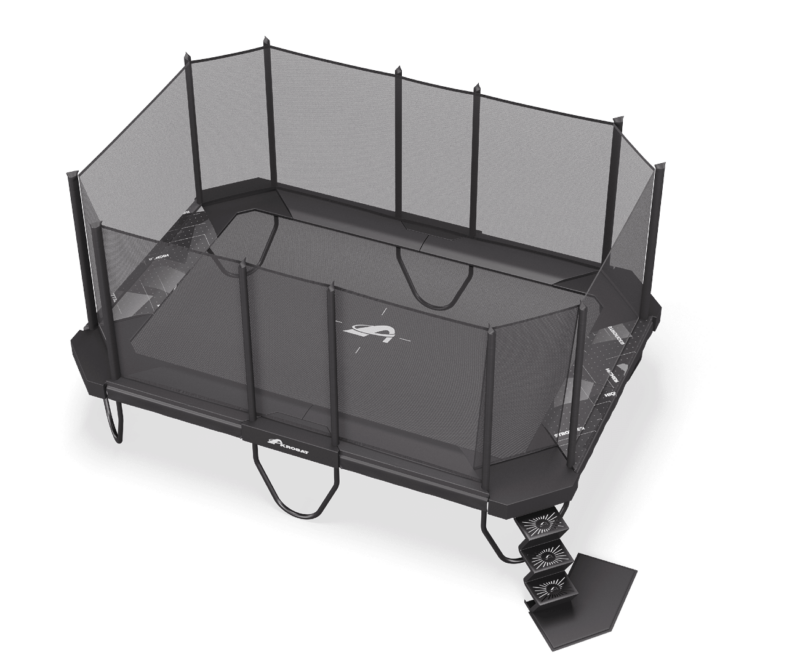
Not everyone wants to dig a massive hole in their backyard—and that’s where a high-quality above-ground trampoline is a great alternative.
The biggest concern with above-ground trampolines is stability under heavy weight, but not all above-ground trampolines are created equal. Many budget models use thin steel frames that flex and wobble, but AkrobatUSA trampolines are engineered for durability.
✅ Hot-Galvanized Steel Frames – AkrobatUSA trampolines use reinforced, weather-resistant steel that won’t bend under weight.
✅ AkroCLICK® Tool-Free Assembly – Unlike standard models that require screws (which can loosen over time), AkroCLICK® ensures a secure, wobble-free setup.
🚨 When to choose an above-ground trampoline:
✔ You want a portable option – Easy to relocate if needed.
✔ You don’t want to dig – In-ground trampolines require excavation and proper drainage.
✔ You need extra bounce height – Above-ground trampolines allow for slightly higher jumps because air circulates underneath the mat.
🏆 Best Pick for Families & Social Jumpers: XCITYX Above-Ground Trampoline (17 ft+)
Choosing a Trampoline That Lasts
If there’s one thing We have learned from years in the trampoline industry, it’s this: you get what you pay for. A trampoline isn’t just a backyard toy—it’s an investment in safety, durability, and performance. And yet, too many people fall for cheap models with exaggerated weight limits, only to find out the hard way that they don’t hold up under real-world use.
So here’s our advice: If you want a trampoline that lasts, one that provides a safer, smoother bounce and stands up to years of use, don’t shop based on price alone. Look at the materials, the engineering, and the real-world weight capacity—not just the marketing claims.
🚨 Avoid trampolines that:
❌ Advertise unrealistic 1,500+ lb weight limits with no structural proof.
❌ Use thin steel frames and low-quality springs that flex and wear out quickly.
❌ Offer short, minimal warranties, leaving you stuck with a failing trampoline.
✅ Instead, choose a trampoline built for real performance.
For adults, gymnasts, and multiple jumpers, a high-performance AkrobatUSA model is your best bet. We design trampolines for real athletes and families—not just for casual use, but for years of safe, high-energy fun.
The AkrobatUSA Difference
✔ Stronger Frames – Hot-galvanized steel for long-lasting durability.
✔ Better Bounce – AkroSPRING® technology for smoother, joint-friendly jumps.
✔ Safer Design – AkroVENT® mats that improve airflow and reduce impact.
✔ Tested & Trusted – Built to withstand 2.5 million jumps.
